 Bug FAQ
Rosemary Beetle
Chrysolina americana · Order: Coleoptera · Family: Chrysomelidae
Source: Wikipedia
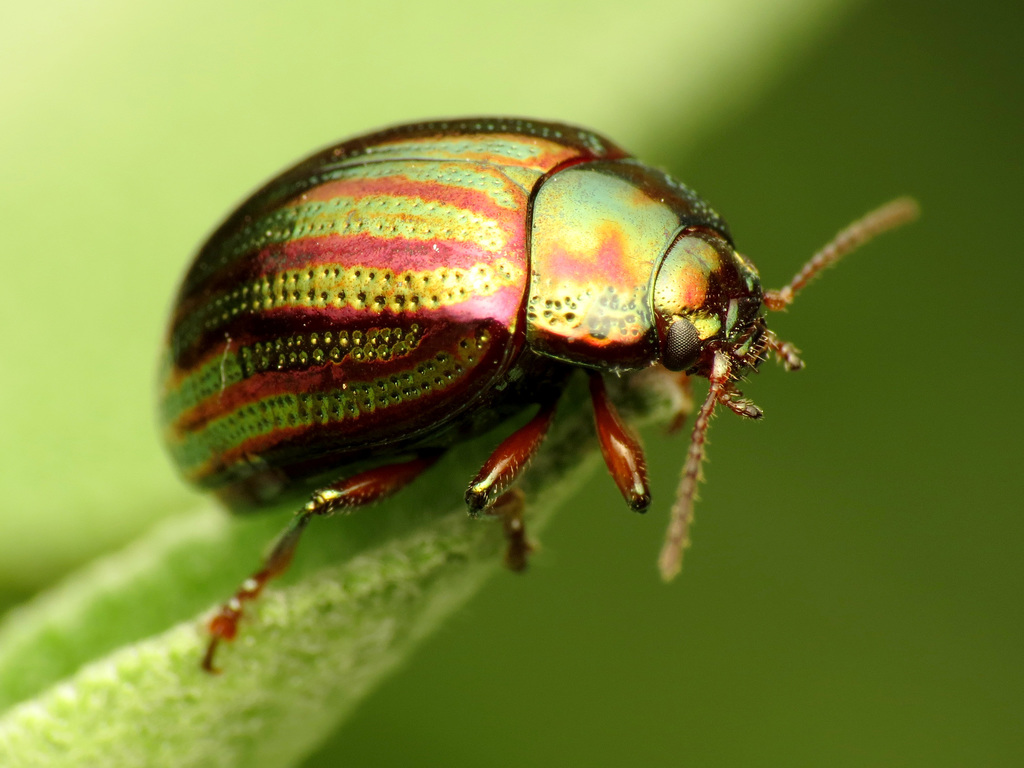
The rosemary beetle is a small leaf beetle with metallic green-purple striped wing covers. It lives outdoors in southern Europe and nearby regions and appears as adults in spring. Control is best by hand-picking or shaking beetles onto paper; chemicals are a last resort.
Source: Wikipedia
How to recognize it
Their wing covers are bright with metallic green and purple stripes. Their wings are short, so they mostly walk and only fly short distances.
Source: Wikipedia
Size
Adults are 5 to 8 mm long.
Source: Wikipedia
Is it a pest in the house?
For culinary herbs, it is advised to pick the beetles off by hand or shake them onto paper.
Source: Wikipedia
How to get rid of it
Hand-picking or shaking beetles onto paper is the recommended control method. They are not a major problem for the plants, so extensive pesticide use is usually unnecessary.
Source: Wikipedia
Where it lives
They were first found living outdoors.
Source: Wikipedia
Life cycle
Females lay eggs on host-plant leaves in late summer. Larvae develop through winter, pupate for about three weeks, and emerge as adults in spring.
Source: Wikipedia
When you see it
Adult beetles appear in the spring.
Source: Wikipedia
More photos


Questions people ask
How can I get rid of them?
Pick them off by hand or shake them onto a sheet of paper; use pesticides only if the infestation is severe.
Source: Wikipedia
Same family (Chrysomelidae)
 Spotted Cucumber BeetleDiabrotica undecimpunctataDamages trees, gardens or crops
 Bean WeevilAcanthoscelides obtectusDamages trees, gardens or crops
 Cowpea WeevilCallosobruchus maculatusDamages trees, gardens or crops
 Swamp Milkweed Leaf BeetleLabidomera clivicollisDamages trees, gardens or crops
 Alder Leaf BeetleAgelastica alniDamages trees, gardens or crops
 Dogbane Leaf BeetleChrysochus auratus
Sources
- Wikipedia: https://en.wikipedia.org/wiki/Chrysolina_americana
Look it up elsewhere: GBIF · iNaturalist · BugGuide · Wikipedia
Text written 2026-10-22 from the sources above and checked sentence by sentence against them. Data fetched 2026-10-22.