 Bug FAQ
Rhopalomyia lobata
Rhopalomyia lobata · Order: Diptera · Family: Cecidomyiidae
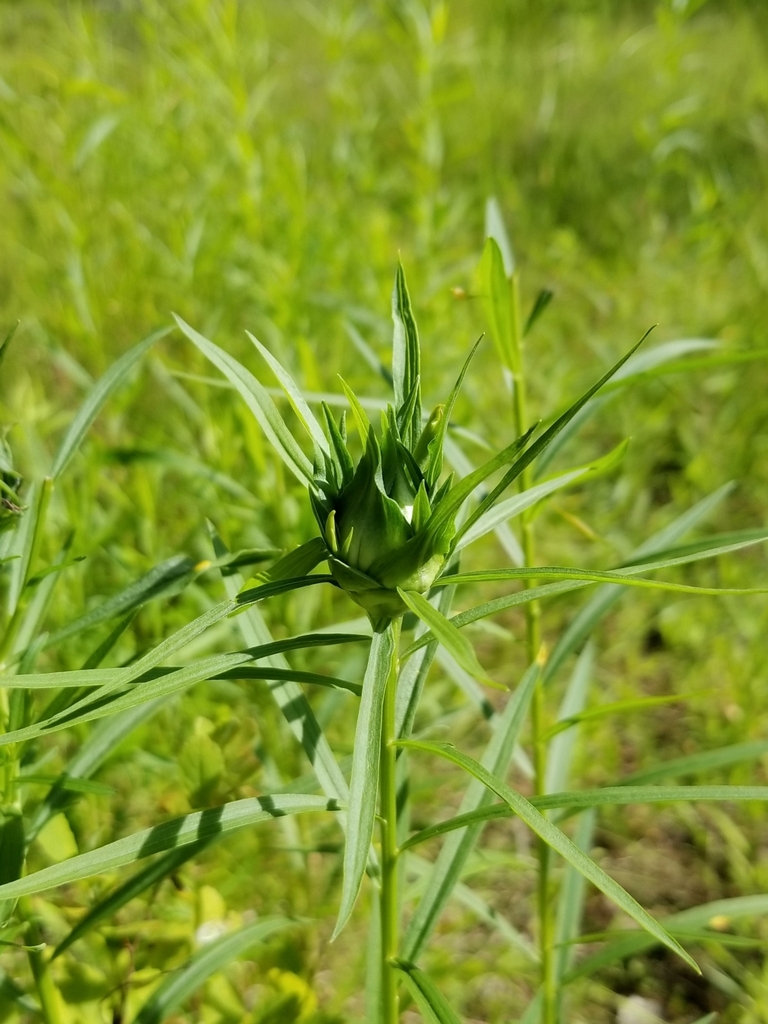
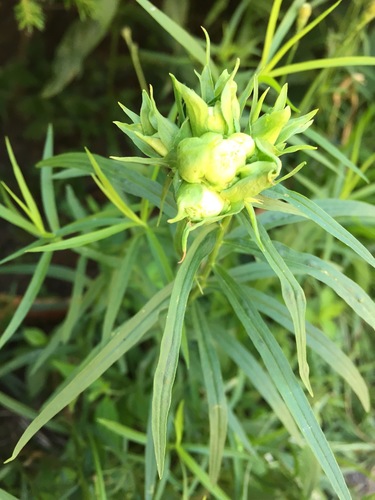
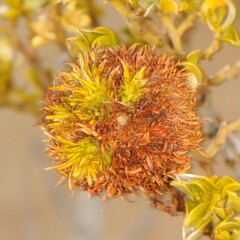
Rhopalomyia lobata makes a spongy gall up to about 6 cm across on the stems and buds of grass-leaved goldenrod. Each gall contains 5 to 35 chambers that hold the midge larvae, and after the adults leave the gall turns black and stays on the plant for weeks. The species occurs from Florida and Mississippi northward to Oregon, New England and much of Canada.
Source: Wikipedia
How to recognize it
The whitish tissue of the gall shows 5 to 35 larval chambers inside. After the midges emerge, the gall darkens to black and remains dry on the plant for several weeks.
Source: Wikipedia
Size
The gall grows to a final diameter of about 6 cm.
Source: Wikipedia
Where it lives
Galls are formed on the stems and buds of the grass-leaved goldenrod (Euthamia graminifolia).
Source: Wikipedia
What it eats
The midge induces galls on grass-leaved goldenrod, using the plant tissue for its larvae.
Source: Wikipedia
Life cycle
Adults emerge from late June to mid-July, exposing the fleshy core of the gall. After emergence, the gall turns black and stays on the plant as a dry structure for several weeks.
Source: Wikipedia
When you see it
Adult midges are active from late June through mid-July. Dry, blackened galls can be seen on plants for several weeks after the adults have left.
Source: Wikipedia
Where it comes from
Rhopalomyia lobata is found across the United States from the Gulf Coast to the Pacific Northwest and throughout much of Canada.
Source: Wikipedia
Where it is found in the US
Recorded in 11 of 51 states and DC. Most records: Vermont, Michigan, Pennsylvania, Minnesota, New York, Maine, New Hampshire, Massachusetts.
Darker = more records. Counts are museum and citizen-science records, not population size.
Source: GBIF
Status: native in North America; native in Canada. Source: iNaturalist
Months it is reported in the US
Source: GBIF
More photos
Questions people ask
When do the adult midges emerge?
Adults emerge from the galls between late June and mid-July.
Source: Wikipedia
What plant does Rhopalomyia lobata use?
It forms galls on the stems and buds of grass-leaved goldenrod (Euthamia graminifolia).
Source: Wikipedia
Same family (Cecidomyiidae)


Sources
- Wikipedia: https://en.wikipedia.org/wiki/Rhopalomyia_lobata
Look it up elsewhere: GBIF · iNaturalist · BugGuide · ITIS · Wikipedia
Text written 2026-10-29 from the sources above and checked sentence by sentence against them. Data fetched 2026-10-29.