 Bug FAQ
Large Creosote Gall Midge
Asphondylia auripila · Order: Diptera · Family: Cecidomyiidae
Also called: Creosote Pom-Pom Gall Midge, Creosote Pompom Gall Midge

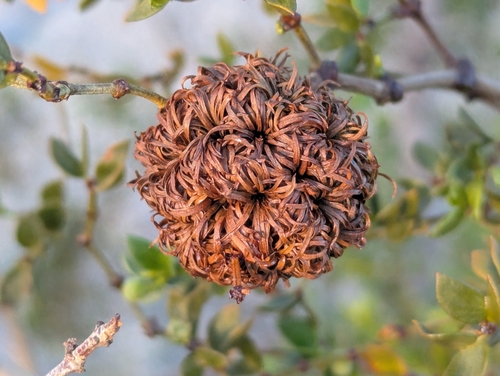
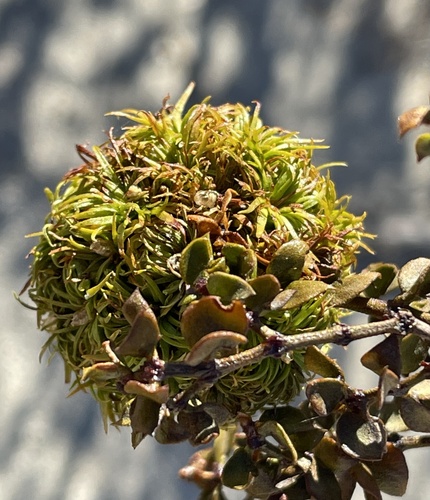
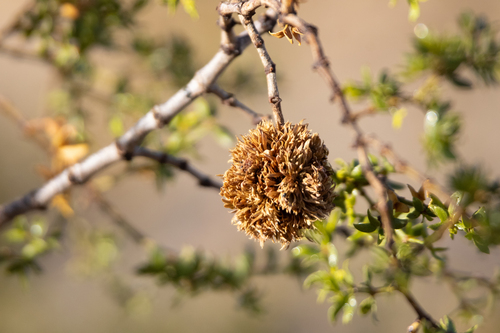
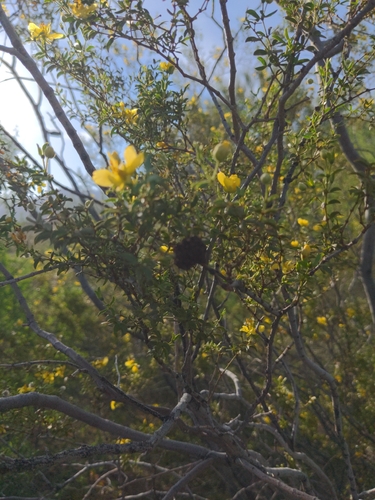
The large creosote gall midge makes a distinctive gall on creosote bushes, but the adult insects look almost identical to other gall midges. Females lay eggs with fungal spores inside the plant part they prefer, and the larvae feed on the fungus that grows in the gall. Adults emerge during periods of plant growth that follow winter, spring, or summer rains.
Source: Wikipedia
How to recognize it
Each species creates a uniquely shaped gall, yet the insects themselves are morphologically very similar and hard to tell apart.
Source: Wikipedia
Where it lives
These midges live on creosote bushes, occupying leaves, stems, buds, and flowers.
Source: Wikipedia
What it eats
The developing larva feeds on the fungus that grows inside its gall.
Source: Wikipedia
Life cycle
The female inserts an egg together with a fungal spore from a mycangium into the plant part she prefers.
Source: Wikipedia
When you see it
Adult emergence is timed with plant growth after winter, spring, or summer rains.
Source: Wikipedia
Lookalikes
Although each species makes a distinct gall, the adult insects look almost identical.
Source: Wikipedia
Where it is found in the US
Recorded in 6 of 51 states and DC. Most records: California, Arizona, Nevada, New Mexico, Texas, Utah.
Darker = more records. Counts are museum and citizen-science records, not population size.
Source: GBIF
Status: native in North America; native in United States. Source: iNaturalist
Months it is reported in the US
Source: GBIF
More photos
Same family (Cecidomyiidae)


Sources
- Wikipedia: https://en.wikipedia.org/wiki/Creosote_gall_midge
Look it up elsewhere: GBIF · iNaturalist · BugGuide · Wikipedia
Text written 2026-10-22 from the sources above and checked sentence by sentence against them. Data fetched 2026-10-22.