 Bug FAQ
Regal Jumping Spider
Phidippus regius · Order: Araneae · Family: Salticidae
Also called: Regal jumper
Source: Wikipedia

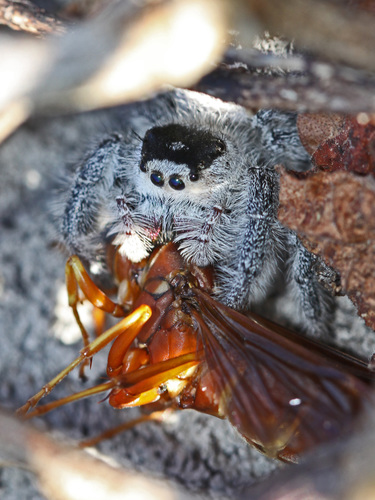
Adult males are about 12 mm long, while females average 15 mm, but both sexes can vary widely in size. They are most often seen hunting on trees, walls, or in open fields and light woods, and they sleep in silken nests inside palm fronds or similar shelters at night.
Source: Wikipedia
How to recognize it
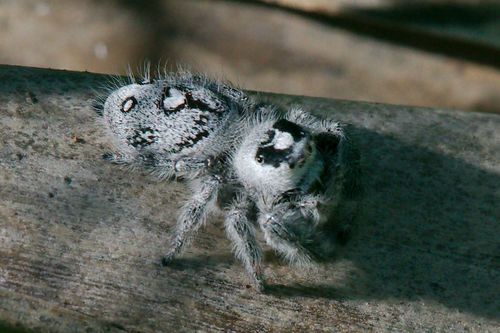
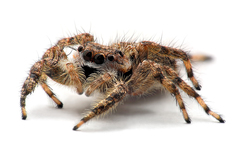
The front legs are much larger in males and have alternating black and white fringe hairs. The abdomen is black with a basal white band, a central triangular white spot, and two white ovals toward the rear.
Source: Wikipedia
Size
Males average 12 mm (0.47 in) long, ranging from 6 to 18 mm. Females average 15 mm (0.59 in) long, ranging from 7 to 22 mm.
Source: Wikipedia
Is it a pest in the house?
Females lay eggs under tree bark or inside wooden structures such as barns.
Source: Wikipedia
Does it bite or sting?
Bites are usually mild but can cause severe pain comparable to a bee sting, with swelling that may last up to three months. The reaction likely depends on individual sensitivity or localized inflammation.
Source: Wikipedia
Where it lives
At night they build silken nests to sleep in, usually inside palm fronds or similar shelters.
Source: Wikipedia
When you see it
Adults are most commonly found in open fields and light woodland during the warmer months. They construct silken night-time nests in palm fronds or similar shelters.
Source: Wikipedia
Where it comes from
In the United States they occur throughout the southeastern states, especially abundant in Florida. Their range also includes the Bahamas, Bermuda, the Greater Antilles, and they have been introduced to Easter Island.
Source: Wikipedia
Lookalikes
It is the largest jumping spider species in eastern North America. Juveniles look pale brown with reddish-brown abdomen markings edged in black.
Source: Wikipedia
Where it is found in the US
Recorded in 16 of 51 states and DC. Most records: Florida, Georgia, South Carolina, North Carolina, Louisiana, Alabama, Pennsylvania, Virginia.
Darker = more records. Counts are museum and citizen-science records, not population size.
Source: GBIF
Status: native in North America. Source: iNaturalist
Months it is reported in the US
Source: GBIF
More photos

Questions people ask
Do they bite?
Yes, their bite can cause severe pain and swelling that may last for months.
Source: Wikipedia
How big are they?
Males average about 12 mm and females about 15 mm, but sizes can range from 6 to 22 mm.
Source: Wikipedia
Where are they found?
They live throughout the southeastern United States, especially Florida, and also in the Bahamas, Bermuda, the Greater Antilles, and have been introduced to Easter Island.
Source: Wikipedia
What do they look like?
Males have large front legs with alternating black-white fringe, and the abdomen is black with distinct white markings.
Source: Wikipedia
Same family (Salticidae)



Sources
- Wikipedia: https://en.wikipedia.org/wiki/Phidippus_regius
Look it up elsewhere: GBIF · iNaturalist · BugGuide · ITIS · Wikipedia
Text written 2026-10-23 from the sources above and checked sentence by sentence against them. Data fetched 2026-10-23.