 Bug FAQ
Poplar Hawkmoth
Laothoe populi · Order: Lepidoptera · Family: Sphingidae
Also called: Poplar Hawk-Moth
Source: Wikipedia
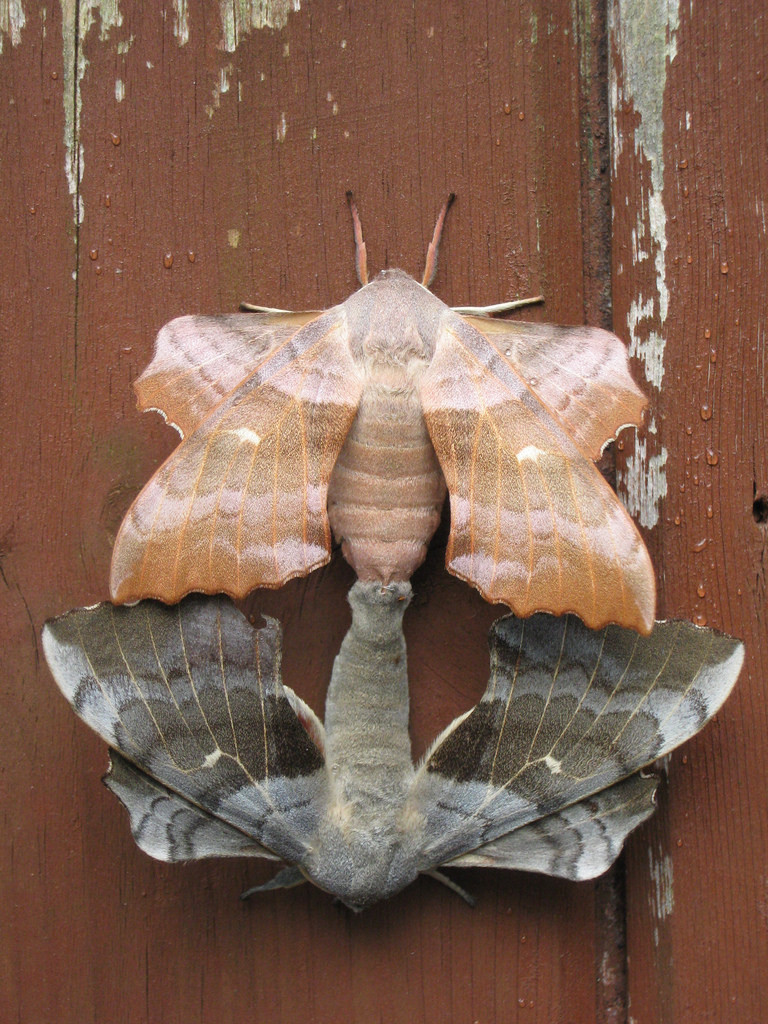
The poplar hawkmoth is a large moth with a wingspan of about 70 to 100 mm. Adults are seen from May to August and the species overwinters as a pupa in the soil near its host plants.
Source: Wikipedia
How to recognize it
The forewings are grey with darker bands and often have a buffish tone, especially in females. A distinctive white spot is present at the distal edge of the forewing cell.
Source: Wikipedia
Size
Wingspan ranges from 70 to 100 mm (2.8 to 3.9 in).
Source: Wikipedia
What it eats
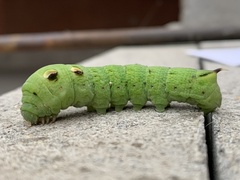
Larvae are green and feed on leaves of poplar, willow, aspen and several other trees.
Source: Wikipedia
Life cycle
One or two generations are produced each year. The species overwinters as a pupa in an earthen cell 2 to 3 cm below the soil surface near its host plant.
Source: Wikipedia
When you see it
Adults can be seen from May through August.
Source: Wikipedia
Where it comes from
Its range covers the Palearctic and Near East areas.
Source: Wikipedia
Lookalikes
It lacks a frenulum joining the wings and resembles a cluster of dead poplar leaves. When mated with the eyed hawkmoth, hybrids can appear with eye spots on the hindwings.
Source: Wikipedia
Where it is found in the US
Recorded in 1 of 51 states and DC. Most records: New Jersey.
Darker = more records. Counts are museum and citizen-science records, not population size.
Source: GBIF
More photos

Same family (Sphingidae)
 White-lined SphinxHyles lineataDamages trees, gardens or crops
 Eurasian Hummingbird HawkmothMacroglossum stellatarum
 Snowberry ClearwingHemaris diffinis
 Carolina SphinxManduca sextaDamages trees, gardens or crops
 Hummingbird ClearwingHemaris thysbeDamages trees, gardens or crops
 Elephant HawkmothDeilephila elpenor
Sources
- Wikipedia: https://en.wikipedia.org/wiki/Poplar_hawkmoth
Look it up elsewhere: GBIF · iNaturalist · BugGuide · Wikipedia
Text written 2026-10-22 from the sources above and checked sentence by sentence against them. Data fetched 2026-10-22.