 Bug FAQ
Pigweed Flea Beetle
Disonycha glabrata · Order: Coleoptera · Family: Chrysomelidae
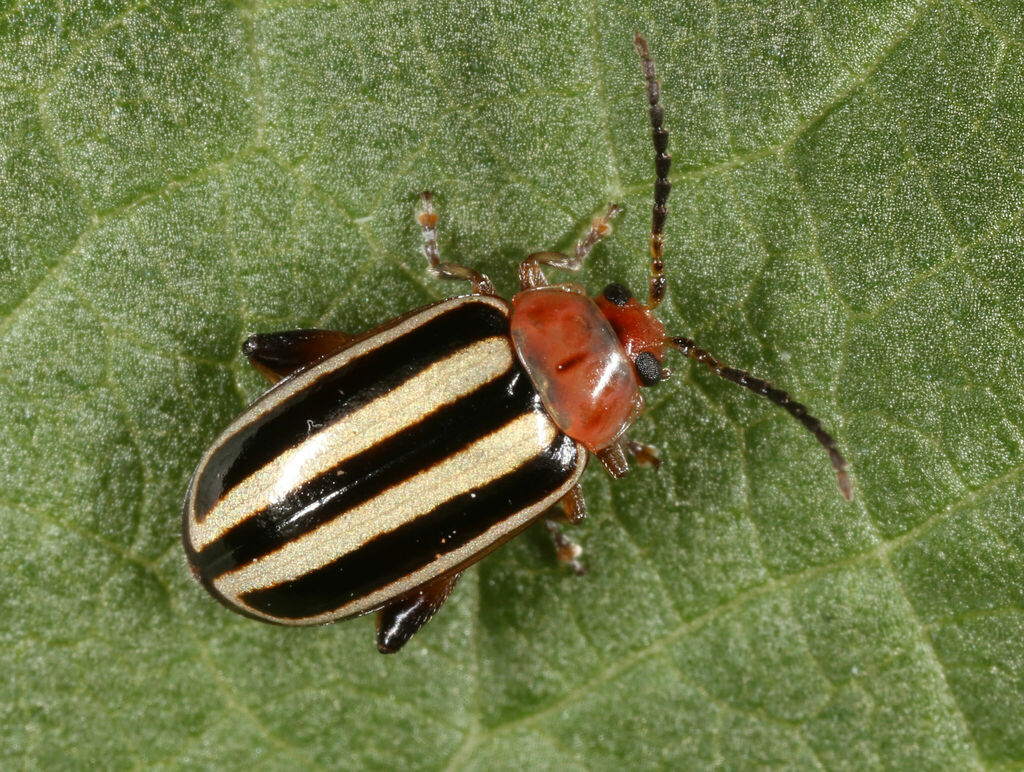
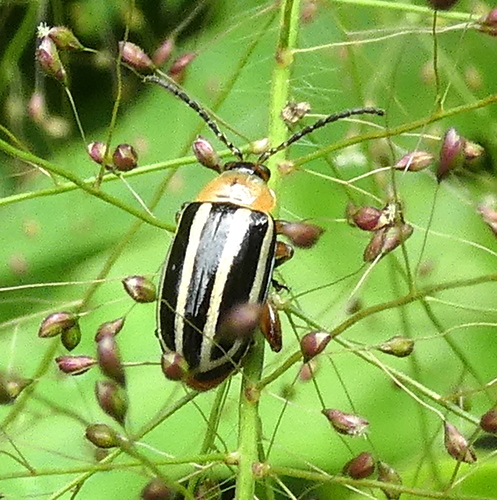
The pigweed flea beetle is a striped flea beetle in the leaf beetle family. It lives on pigweed (Amaranthus retroflexus), where it both eats the plant and lays its eggs. Its larvae go through three growth stages lasting about 3.6, 2.6 and 2.9 days, spending roughly two weeks in the soil.
Source: Wikipedia
How to recognize it
Disonycha glabrata is a striped flea beetle in the family Chrysomelidae.
Source: Wikipedia
Where it lives
It feeds on Amaranthus retroflexus and lays its eggs in that plant.
Source: Wikipedia
What it eats
Its food source is the pigweed Amaranthus retroflexus.
Source: Wikipedia
Life cycle
The first larval stage lasts 3.6 days, the second 2.6 days, and the third 2.9 days, with about 13.5 days spent in the soil.
Source: Wikipedia
Where it is found in the US
Recorded in 33 of 51 states and DC. Most records: Texas, Pennsylvania, Kentucky, Arizona, Indiana, Virginia, Maryland, North Carolina.
Darker = more records. Counts are museum and citizen-science records, not population size.
Source: GBIF
Status: native in North America. Source: iNaturalist
Months it is reported in the US
Source: GBIF
More photos
Same family (Chrysomelidae)
 Spotted Cucumber BeetleDiabrotica undecimpunctataDamages trees, gardens or crops
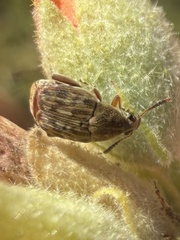 Bean WeevilAcanthoscelides obtectusDamages trees, gardens or crops
 Cowpea WeevilCallosobruchus maculatusDamages trees, gardens or crops
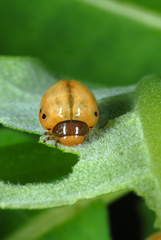 Swamp Milkweed Leaf BeetleLabidomera clivicollisDamages trees, gardens or crops
 Alder Leaf BeetleAgelastica alniDamages trees, gardens or crops
 Dogbane Leaf BeetleChrysochus auratus
Sources
- Wikipedia: https://en.wikipedia.org/wiki/Disonycha_glabrata
Look it up elsewhere: GBIF · iNaturalist · BugGuide · ITIS · Wikipedia
Text written 2026-10-22 from the sources above and checked sentence by sentence against them. Data fetched 2026-10-22.