 Bug FAQ
Phidippus californicus
Phidippus californicus · Order: Araneae · Family: Salticidae
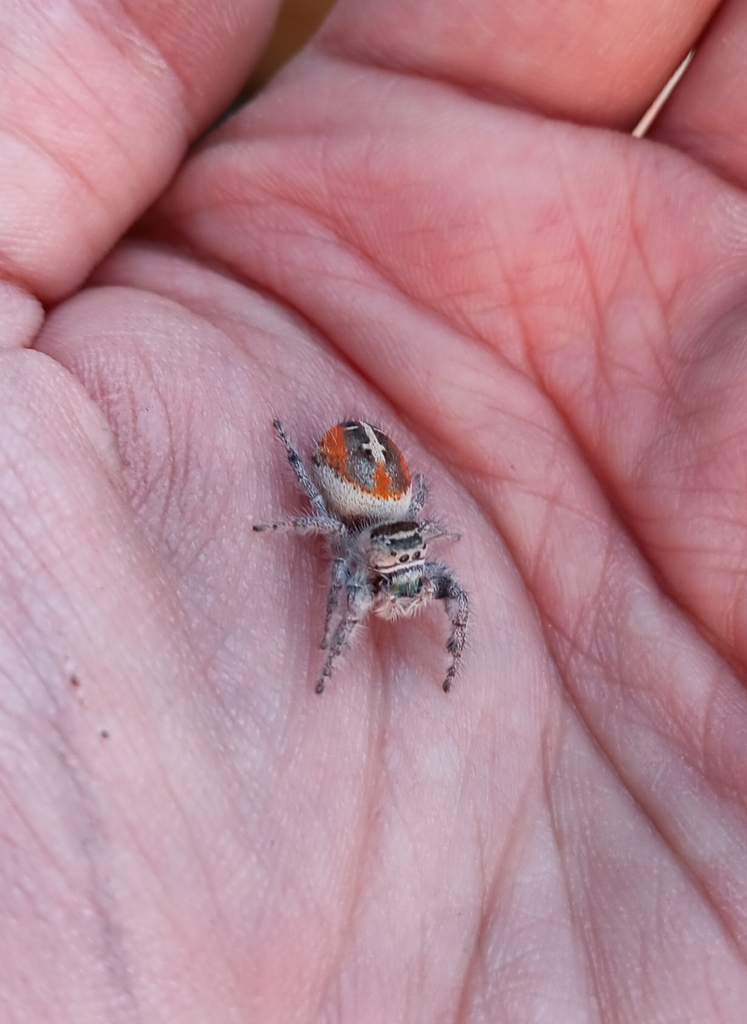
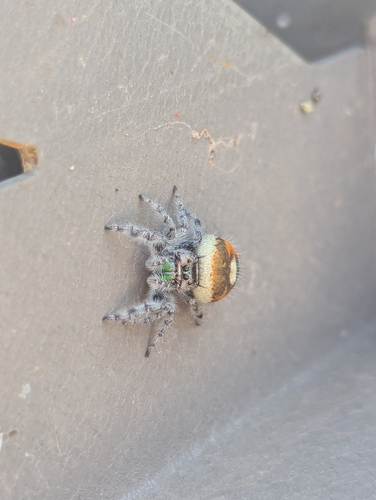
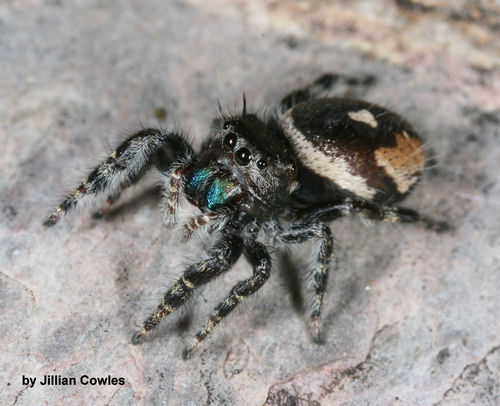
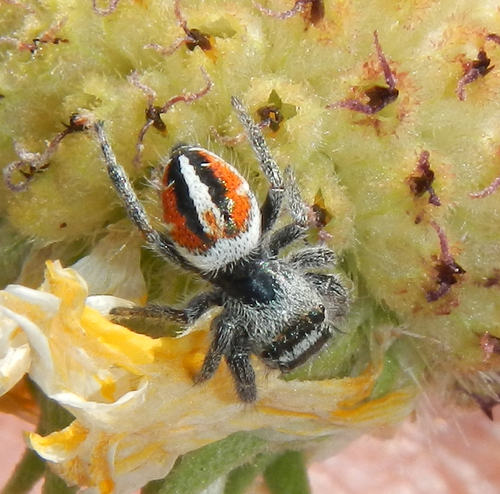
Adult females grow up to about 12 mm long while males range from 7 to 11 mm. They have blue-green chelicerae, a black body and legs, and a bright red abdomen marked with a central black stripe, light diagonal side bands and a light front band. These jumping spiders live on sagebrush, rabbitbrush and four-winged saltbrush in the Great Basin Desert of the southwestern United States and northern Mexico.
Source: Wikipedia
How to recognize it
The abdomen also has light diagonal bands on the sides and a light transverse band near the front.
Source: Wikipedia
Size
Females can reach a body length of about 12 mm; males are between 7 and 11 mm long.
Source: Wikipedia
Where it lives
You will find it on bushes such as sagebrush, rabbitbrush and four-winged saltbrush.
Source: Wikipedia
What it eats
It rarely starts a hunt on still prey and will stop hunting if the prey stops moving. When it does chase prey, it begins with a rapid sprint that slows as it gets closer.
Source: Wikipedia
Life cycle
A female lays two to three successive egg batches, each containing fewer eggs than the previous one. Spiderlings hatch after about three weeks, stay in the nest until after their first molt roughly two weeks later, then become independent.
Source: Wikipedia
When you see it
Adult males are present from early April through July, while females appear from early May through July.
Source: Wikipedia
Where it comes from
It is native to the southwestern United States, including California, Arizona, New Mexico, Nevada, Texas and Utah, and northern Mexico, especially Baja California and Sonora.
Source: Wikipedia
Lookalikes
It mimics velvet ants of the genus Dasymutilla, which are mutillid wasps. Males and females look alike in coloration, a trait it shares with Phidippus apacheanus.
Source: Wikipedia
Where it is found in the US
Recorded in 12 of 51 states and DC. Most records: California, Arizona, Nevada, New Mexico, Utah, Oregon, Texas, Idaho.
Darker = more records. Counts are museum and citizen-science records, not population size.
Source: GBIF
Status: native in North America; native in Canada; native in United States. Source: iNaturalist
Months it is reported in the US
Source: GBIF
More photos
Questions people ask
What does Phidippus californicus look like?
It has blue-green chelicerae, a black body and legs, and a bright red abdomen with a central black stripe, plus light side and front bands.
Source: Wikipedia
Where does Phidippus californicus live?
It lives on sagebrush, rabbitbrush and four-winged saltbrush in the Great Basin Desert of the southwestern U.S. and northern Mexico.
Source: Wikipedia
What other insects does Phidippus californicus resemble?
It mimics velvet ants (mutillid wasps) and looks similar in color to Phidippus apacheanus.
Source: Wikipedia
Same family (Salticidae)



Sources
- Wikipedia: https://en.wikipedia.org/wiki/Phidippus_californicus
Look it up elsewhere: GBIF · iNaturalist · BugGuide · ITIS · Wikipedia
Text written 2026-10-25 from the sources above and checked sentence by sentence against them. Data fetched 2026-10-25.