 Bug FAQ
Pecan Cigar Casebearer
Coleophora laticornella · Order: Lepidoptera · Family: Coleophoridae
Source: Wikipedia
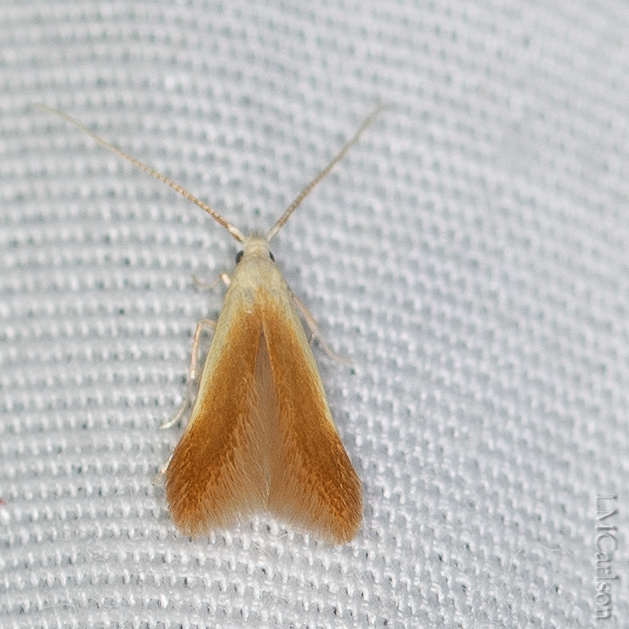
The adult has a wingspan of roughly 25 mm. It lives across North America. Its caterpillars feed on pecan, other hickories, black walnut and American plum.
Source: Wikipedia
How to recognize it
The larvae build a flat, spoon-shaped case from leaf material.
Source: Wikipedia
Size
Adults measure about 25 mm from wing tip to wing tip.
Source: Wikipedia
Where it lives
The species is found throughout North America.
Source: Wikipedia
What it eats
Larvae eat the leaves of pecan and other Carya species, as well as black walnut and American plum.
Source: Wikipedia
Life cycle
During development the caterpillars construct a spatulate leaf case.
Source: Wikipedia
Where it comes from
It is native to North America.
Source: Wikipedia
Where it is found in the US
Recorded in 16 of 51 states and DC. Most records: Alabama, West Virginia, Mississippi, Michigan, Arkansas, Virginia, Texas, Illinois.
Darker = more records. Counts are museum and citizen-science records, not population size.
Source: GBIF
Status: native in North America; native in Canada. Source: iNaturalist
Months it is reported in the US
Source: GBIF
Questions people ask
What plants do the larvae feed on?
They consume leaves of pecan, other hickories, black walnut and American plum.
Source: Wikipedia
What does the larval case look like?
The caterpillars make a flat, spoon-shaped case from pieces of leaf.
Source: Wikipedia
Same family (Coleophoridae)



Sources
- Wikipedia: https://en.wikipedia.org/wiki/Coleophora_laticornella
Look it up elsewhere: GBIF · iNaturalist · BugGuide · ITIS · Wikipedia
Text written 2026-10-29 from the sources above and checked sentence by sentence against them. Data fetched 2026-10-29.