 Bug FAQ
Peaceful Cicada
Chremistica ochracea · Order: Hemiptera · Family: Cicadidae
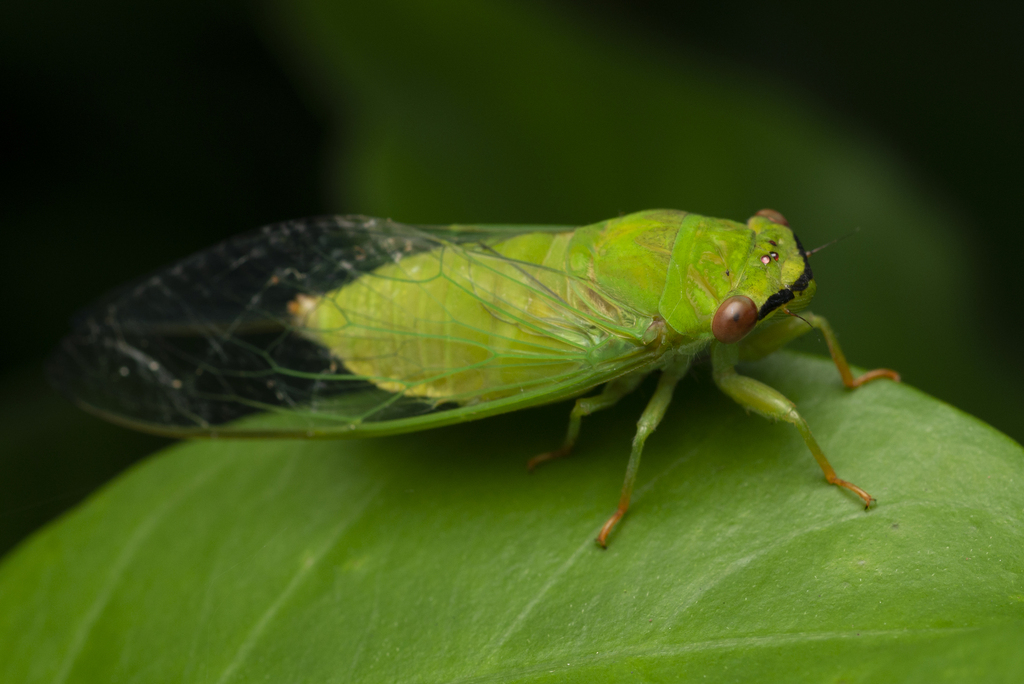
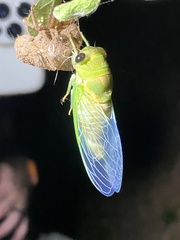
The peaceful cicada (Chremistica ochracea) is a green insect with thin, transparent wings and may show light green, earthy red or yellow body tones. Adults are 31 mm long for males and 24.4 mm for females, with total lengths up to 45 mm and 43 mm respectively.
Source: Wikipedia
How to recognize it
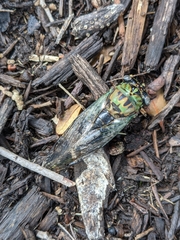
They have a green body, thin transparent wings, and may show light green, earthy red or yellow coloration. A black band runs across the front of the head and black spots border each ocellus near the reddish eyes.
Source: Wikipedia
Size
Male bodies reach up to 31 mm and females up to 24.4 mm in length. Including wings, males can be as long as 45 mm and females 43 mm.
Source: Wikipedia
Where it lives
They live in lowlands and low-montane zones of Taiwan, the Oriental region and America.
Source: Wikipedia
What it eats
They are more common in plantation areas and fragmented forests than in continuous forests. Their nymphs emerge earlier than those of other cicada species in the same region.
Source: Wikipedia
Life cycle
After rains, many shed skins (exuviae) can be found on the ground.
Source: Wikipedia
When you see it
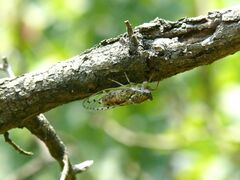
Adults are active from April through September, with males singing to attract females. They are most often seen perched on twigs during the day in June and July.
Source: Wikipedia
Where it comes from
Chremistica ochracea belongs to the suborder Auchenorrhyncha, which also includes leafhoppers, planthoppers and related insects.
Source: Wikipedia
Lookalikes
It was once placed in the genus Rihana as Rihana ochracea. The genus Chremistica is part of the tribe Tibicenini, related to Tibicen, Cryptotympana and others.
Source: Wikipedia
Questions people ask
When are adult peaceful cicadas active?
Adults are seen from April to September, especially in June and July, and males sing to attract females.
Source: Wikipedia
Same family (Cicadidae)
Sources
- Wikipedia: https://en.wikipedia.org/wiki/Chremistica_ochracea
Look it up elsewhere: GBIF · iNaturalist · BugGuide · Wikipedia
Text written 2026-10-23 from the sources above and checked sentence by sentence against them. Data fetched 2026-10-22.