 Bug FAQ
Pasture Locust
Orphulella speciosa · Order: Orthoptera · Family: Acrididae
Also called: Pasture Grasshopper, Slant-faced Pasture Grasshopper

Pasture Locusts have a very slanted face and show many green-brown color mixes. Females are 16-21.5 mm long; males are 13-14 mm, with antennae around 5 mm and hind femora about 9-12 mm. They live in tall-grass and mixed-grass prairies, especially in shorter, grazed patches, and are most common in August-October in the south and July-August in the north.
Source: Wikipedia
How to recognize it
The species has a strongly slanted face. Its body color varies widely, often mixing green and brown shades.
Source: Wikipedia
Size
Females measure 16-21.5 mm in body length; their antennae are 5-6 mm, tegmina 9-16 mm, and hind femora 9.5-12 mm. Males are 13-14 mm long, with antennae 4.5-6.5 mm, tegmina about 10-13 mm, and hind femora 8.5-10 mm.
Source: Wikipedia
Where it lives
They inhabit tall-grass and mixed-grass prairies, preferring shorter, grazed grass patches within the prairie matrix.
Source: Wikipedia
What it eats
Nymphs undergo incomplete metamorphosis, passing through five instars before becoming adults. Early instars show green head patterns and expanded antennae; later instars display tan, brown, green, or gray colors with brownish-gray hind femora.
Source: Wikipedia
Life cycle
The species has five nymphal stages, molting four times before reaching adulthood. First and second instars have green head markings and antennae that grow outward from the head.
Source: Wikipedia
When you see it
In the southern part of its range, adults are most abundant from August to October, with fewer seen from May to December. In the northern part of its range, adults peak in July and August.
Source: Wikipedia
Where it comes from
They occur east of the Rockies across the United States to the Atlantic coast. Their range also includes southern Canada and northern Mexico.
Source: Wikipedia
Lookalikes
It looks very similar to the related species O. pelidna, but the two can be separated by examining the size of the fastigium between the eyes.
Source: Wikipedia
Where it is found in the US
Recorded in 43 of 51 states and DC. Most records: Texas, Michigan, Pennsylvania, Oklahoma, Kansas, Tennessee, Colorado, Illinois.
Darker = more records. Counts are museum and citizen-science records, not population size.
Source: GBIF
Status: native in North America; native in Canada. Source: iNaturalist
Months it is reported in the US
Source: GBIF
More photos
Same family (Acrididae)
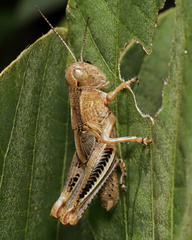 Differential GrasshopperMelanoplus differentialisDamages trees, gardens or crops
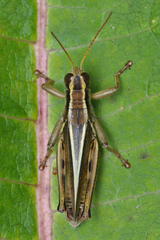 Two-striped GrasshopperMelanoplus bivittatusDamages trees, gardens or crops
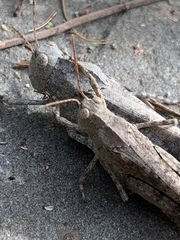 Carolina GrasshopperDissosteira carolinaDamages trees, gardens or crops
 Common Field GrasshopperChorthippus brunneus
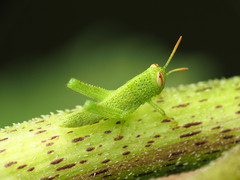 Egyptian Bird GrasshopperAnacridium aegyptium
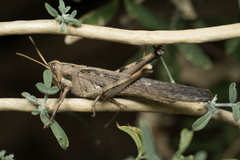 Gray Bird GrasshopperSchistocerca nitensDamages trees, gardens or crops
Sources
- Wikipedia: https://en.wikipedia.org/wiki/Orphulella_speciosa
Look it up elsewhere: GBIF · iNaturalist · BugGuide · ITIS · Wikipedia
Text written 2026-10-23 from the sources above and checked sentence by sentence against them. Data fetched 2026-10-23.