 Bug FAQ
Passionflower Flea Beetle
Disonycha discoidea · Order: Coleoptera · Family: Chrysomelidae
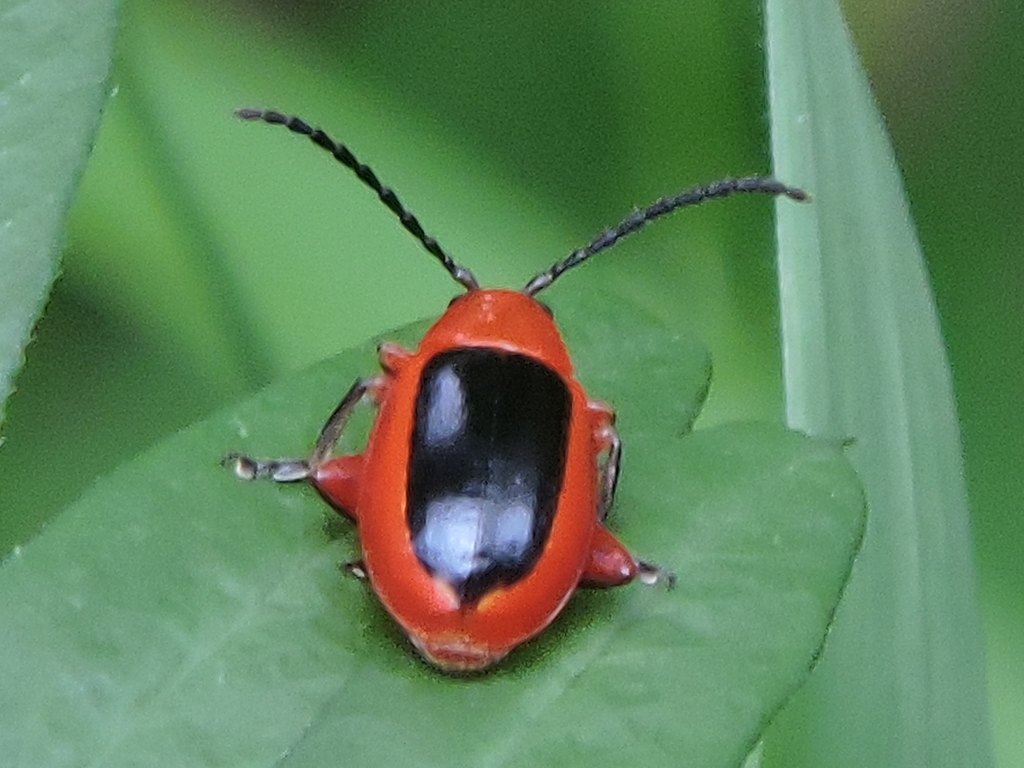
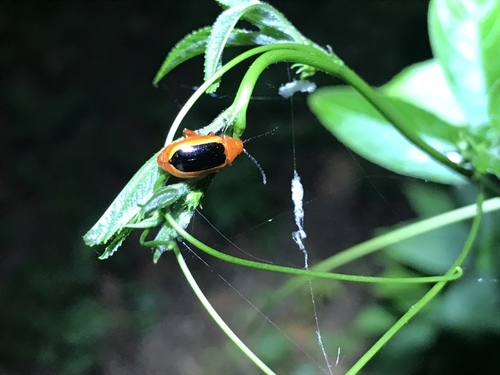
The adult is about 7 mm long and 4 mm wide, making it large for a flea beetle. It has an oval orange-red body and dark antennae, with the base and tip sometimes lighter.
Source: Wikipedia
How to recognize it
The beetle’s body is oval and orange-red, turning yellow as preserved specimens age. Antennae are dark, with the first and last segments sometimes paler.
Source: Wikipedia
Size
Adults measure roughly 7 mm in length and 4 mm in width.
Source: Wikipedia
Where it lives
Adults spend the winter under plant leaves or underground.
Source: Wikipedia
What it eats
It specializes on passionflower species, feeding on yellow and purple passionflower. It has also been reported on Euonymus atropurpureus, though that may involve a different, undescribed species.
Source: Wikipedia
Life cycle
Adults overwinter under leaves or in the soil and emerge in spring to lay eggs near host plants. Larvae feed in groups on host leaves, then pupate underground.
Source: Wikipedia
When you see it
New adults appear in spring after overwintering.
Source: Wikipedia
Where it is found in the US
Recorded in 19 of 51 states and DC. Most records: Texas, North Carolina, Virginia, South Carolina, Arkansas, Tennessee, Alabama, Georgia.
Darker = more records. Counts are museum and citizen-science records, not population size.
Source: GBIF
Months it is reported in the US
Source: GBIF
More photos
Questions people ask
When do these beetles become active?
Adults emerge in spring, lay eggs near passionflower, and the larvae develop through the growing season.
Source: Wikipedia
What plants do they eat?
They feed on yellow and purple passionflower, and have also been reported on Euonymus atropurpureus.
Source: Wikipedia
Where are they found in the United States?
Their range includes the eastern U.S., from Texas and Kansas eastward to Georgia and Maryland.
Source: Wikipedia
Same family (Chrysomelidae)
 Spotted Cucumber BeetleDiabrotica undecimpunctataDamages trees, gardens or crops
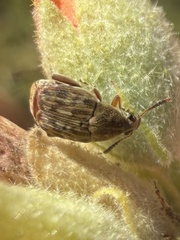 Bean WeevilAcanthoscelides obtectusDamages trees, gardens or crops
 Cowpea WeevilCallosobruchus maculatusDamages trees, gardens or crops
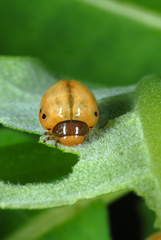 Swamp Milkweed Leaf BeetleLabidomera clivicollisDamages trees, gardens or crops
 Alder Leaf BeetleAgelastica alniDamages trees, gardens or crops
 Dogbane Leaf BeetleChrysochus auratus
Sources
- Wikipedia: https://en.wikipedia.org/wiki/Disonycha_discoidea
Look it up elsewhere: GBIF · iNaturalist · BugGuide · ITIS · Wikipedia
Text written 2026-10-24 from the sources above and checked sentence by sentence against them. Data fetched 2026-10-24.