 Bug FAQ
Parthenium beetle
Calligrapha bicolorata · Order: Coleoptera · Family: Chrysomelidae
Also called: Calligrapher Beetles, Calligraphy Beetles
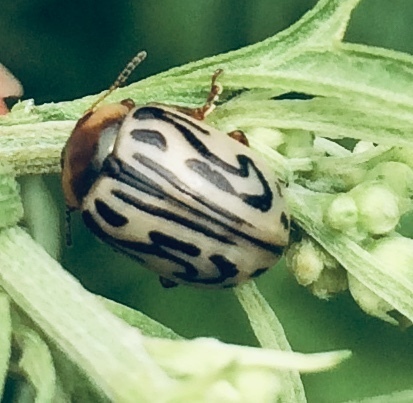
It is native to Mexico and has been introduced to India and Australia, where adults and larvae are released to control the invasive weed Parthenium hysterophorus.
Source: Wikipedia
How to recognize it
The beetle’s elytral pattern is variable; a study of 478 specimens found 29 different stripe arrangements.
Source: Wikipedia
Size
It is a small beetle with a brown head, brown-yellow pronotum and yellow elytra marked with elongated brown stripes.
Source: Wikipedia
How to get rid of it
The beetle is released as a biological control agent to suppress Parthenium hysterophorus populations.
Source: Wikipedia
What it eats
Both adults and larvae feed on the invasive weed Parthenium hysterophorus.
Source: Wikipedia
Life cycle
Females lay eggs on the underside of leaves, sometimes on the upper leaf surface, stems or flowers. The complete life cycle takes just over 100 days.
Source: Wikipedia
Where it comes from
Its original range is Mexico; it now occurs in India and Australia after introduction.
Source: Wikipedia
Where it is found in the US
Recorded in 51 of 51 states and DC. Most records: Texas, Arizona, Oregon, Vermont, New York, Colorado, New Mexico, Massachusetts.
Darker = more records. Counts are museum and citizen-science records, not population size.
Source: GBIF
Months it is reported in the US
Source: GBIF
Questions people ask
How is the Parthenium beetle used in pest control?
Adults and larvae are released to feed on and reduce the invasive weed Parthenium hysterophorus.
Source: Wikipedia
Where does this beetle come from?
It is native to Mexico and has been introduced to India and Australia.
Source: Wikipedia
Same family (Chrysomelidae)
 Spotted Cucumber BeetleDiabrotica undecimpunctataDamages trees, gardens or crops
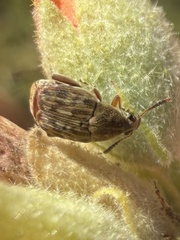 Bean WeevilAcanthoscelides obtectusDamages trees, gardens or crops
 Cowpea WeevilCallosobruchus maculatusDamages trees, gardens or crops
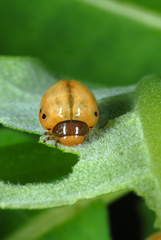 Swamp Milkweed Leaf BeetleLabidomera clivicollisDamages trees, gardens or crops
 Alder Leaf BeetleAgelastica alniDamages trees, gardens or crops
 Dogbane Leaf BeetleChrysochus auratus
Sources
- Wikipedia: https://en.wikipedia.org/wiki/Calligrapha_bicolorata
Look it up elsewhere: GBIF · iNaturalist · BugGuide · Wikipedia
Text written 2026-10-23 from the sources above and checked sentence by sentence against them. Data fetched 2026-10-23.