 Bug FAQ
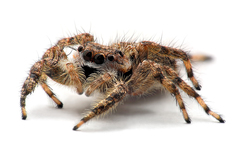
Pantropical Jumping Spider
Plexippus paykulli · Order: Araneae · Family: Salticidae
Also called: jumping spider, Pantropical Jumper, Pantropical Wall Jumper, jumping spiders
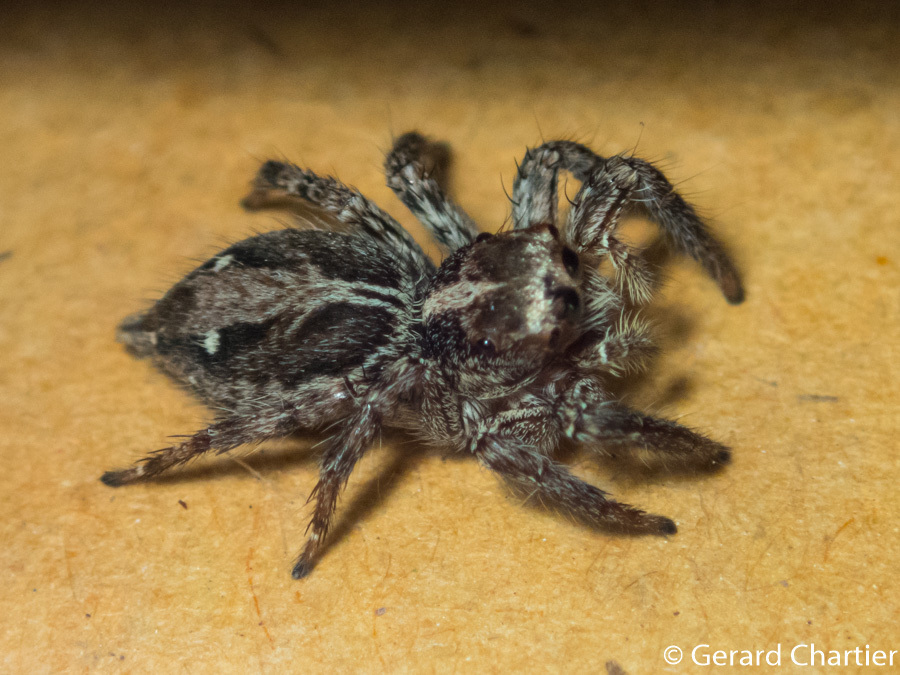
The pantropical jumping spider is about 9 to 12 mm long, with males and females looking different. It lives on buildings and other man-made structures, sometimes near lights, and it hunts a wide range of insects and other spiders. Females lay a silken egg sac about 3 cm across under floorboards or in cracks and guard it until the spiderlings hatch in three to four weeks.
Source: Wikipedia
How to recognize it
Males have a black carapace and an abdomen with a broad white stripe down the middle, another stripe on each side, and two white spots near the rear. Females are brown-grey with a darker carapace around the eyes and a wide tan stripe that continues onto the abdomen and splits into two chevrons.
Source: Wikipedia
Is it a pest in the house?
It helps control mosquitoes inside African homes and feeds on agricultural pests like the cotton jassid and sugarcane planthopper.
Source: Wikipedia
Where it lives
It is commonly found on and around buildings, especially near lights that attract insects. It has also been recorded in citrus groves and cotton fields.
Source: Wikipedia
What it eats
It is a generalist predator that overpowers insects and other spiders. In New Zealand it was observed eating sixteen arthropod species from fourteen families and six orders.
Source: Wikipedia
Life cycle
The female builds an eggsac about 3 cm in diameter in hidden spots such as under floorboards, cracks, or eaves. Inside a lens-shaped silken case she places 35 to 60 eggs, guards them, and the spiderlings emerge after three to four weeks.
Source: Wikipedia
Where it comes from
The species is native to tropical parts of Africa and Asia. Originally from Southeast Asia, it now occurs worldwide.
Source: Wikipedia
Where it is found in the US
Recorded in 31 of 51 states and DC. Most records: Texas, Florida, Georgia, Louisiana, Alabama, South Carolina, Mississippi, California.
Darker = more records. Counts are museum and citizen-science records, not population size.
Source: GBIF
Status: introduced in North America; introduced in United States. Source: iNaturalist
Months it is reported in the US
Source: GBIF
More photos


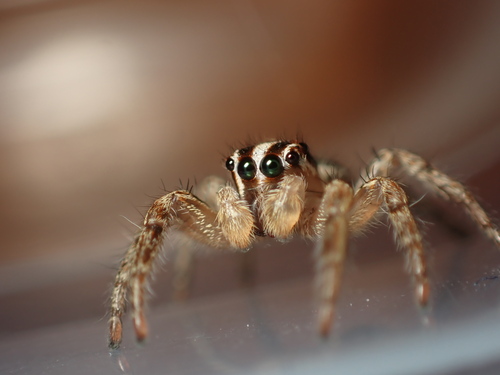
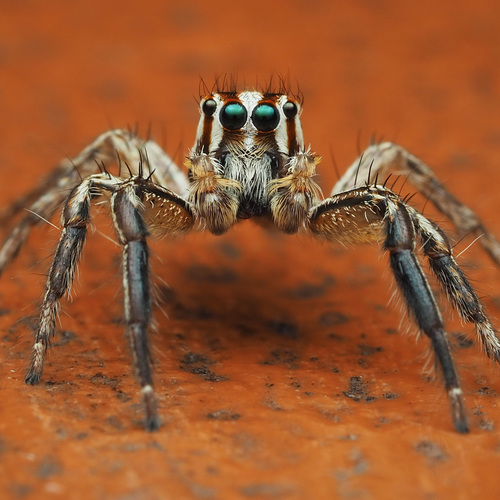
Same family (Salticidae)
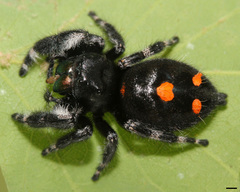



Sources
- Wikipedia: https://en.wikipedia.org/wiki/Plexippus_paykulli
Look it up elsewhere: GBIF · iNaturalist · BugGuide · ITIS · Wikipedia
Text written 2026-10-22 from the sources above and checked sentence by sentence against them. Data fetched 2026-10-22.