 Bug FAQ
Pantropical Huntsman Spider
Heteropoda venatoria · Order: Araneae · Family: Sparassidae
Also called: Huntsman Spider, banana spider, brown house spider, brown huntsman spider
Source: Wikipedia

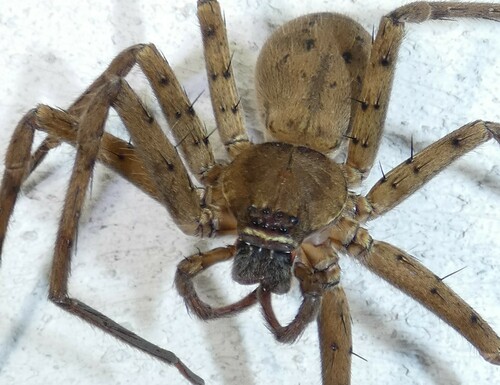
Adult pantropical huntsman spiders are about 2.5 cm long with legs that can span up to 10 cm. They live mainly inside homes, barns or sheds, especially where it gets cold, because they cannot survive outdoors in cooler climates. They hunt insects, moths, butterflies, scorpions and even bats, but they do not damage crops or structures.
Source: Wikipedia
How to recognize it
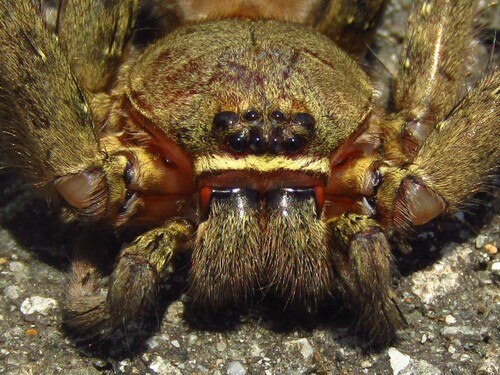
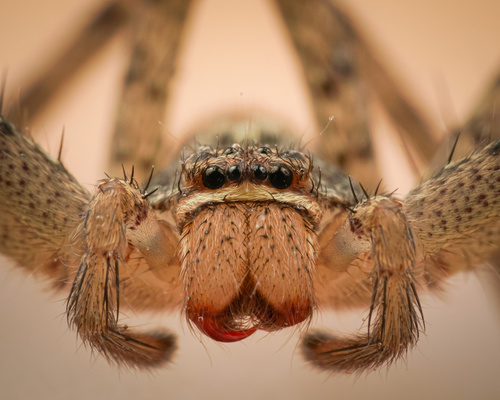
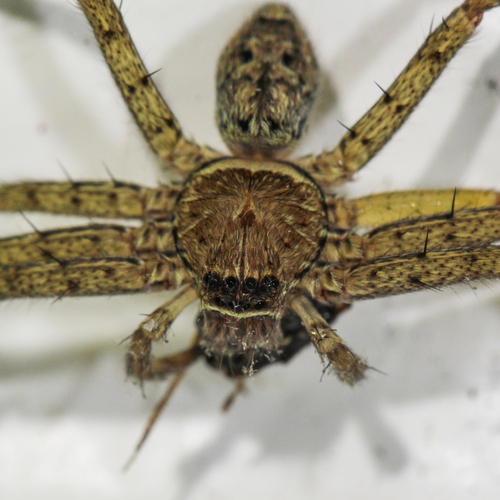
The area in front of the eyes is cream-yellow, and the carapace has a wide tan band in females or cream in males. The legs have upright hairs each marked with a tiny black dot, while the body itself is not very hairy.
Source: Wikipedia
Does it bite or sting?
The spider’s bite is not considered dangerous but can cause noticeable pain.
Source: Wikipedia
Where it lives
They are commonly found inside houses, barns and sheds, especially where temperatures drop. They cannot live outdoors in cold areas and need warm climates to survive outside.
Source: Wikipedia
What it eats
They prey on insects such as butterflies and moths. They also capture scorpions and even small bats.
Source: Wikipedia
Life cycle
Females carry an egg sac about 2.5 cm wide beneath their body with their pedipalps. In a lab sample, males lived about 465 days and females about 580 days.
Source: Wikipedia
Where it comes from
They originate from tropical regions worldwide and have been introduced to some subtropical areas.
Source: Wikipedia
Lookalikes
In Bermuda they are often called house spiders or sometimes wolf spiders, which can cause confusion with other species.
Source: Wikipedia
Where it is found in the US
Recorded in 21 of 51 states and DC. Most records: Florida, Hawaii, Texas, Georgia, Louisiana, Alabama, Massachusetts, California.
Darker = more records. Counts are museum and citizen-science records, not population size.
Source: GBIF
Status: introduced in North America; introduced in Canada. Source: iNaturalist
Months it is reported in the US
Source: GBIF
More photos
Questions people ask
Do they bite people?
Yes, they can bite and the bite is painful but not medically serious.
Source: Wikipedia
What do they eat?
They hunt insects, moths, butterflies, scorpions and even small bats.
Source: Wikipedia
Where are they usually found in a home?
They are most often found inside houses, barns and sheds, especially where it gets cold.
Source: Wikipedia
Same family (Sparassidae)


Sources
- Wikipedia: https://en.wikipedia.org/wiki/Heteropoda_venatoria
Look it up elsewhere: GBIF · iNaturalist · BugGuide · ITIS · Wikipedia
Text written 2026-10-23 from the sources above and checked sentence by sentence against them. Data fetched 2026-10-22.