 Bug FAQ
Green Huntsman Spider
Micrommata virescens · Order: Araneae · Family: Sparassidae
Also called: Green Spider
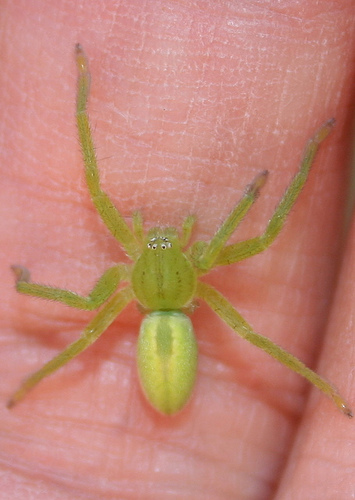
Female green huntsman spiders are 12 to 16 mm long, bright green on the body and legs, with a lighter abdomen marked by a dark stripe; males are smaller (7 to 10 mm), dark green-olive with red sides and a red-brown stripe bordered in yellow. They live in forest edges, dry meadows, damp woodland clearings and rides, favoring grass and low tree branches.
Source: Wikipedia
How to recognize it
Females have a bright green cephalothorax and long legs, with a lighter green abdomen that shows a darker green central stripe. Males are dark green-olive, have a narrower abdomen, and display red sides with a red-brown central stripe edged in yellow.
Source: Wikipedia
Size
Females reach 12 to 16 mm in body length, while males are about 7 to 10 mm long.
Source: Wikipedia
Where it lives
They are found at forest edges, in dry meadows, damp woodland clearings and rides, preferring grass and lower tree branches.
Source: Wikipedia
Life cycle
It takes about 18 months for them to reach maturity. Eggs hatch after roughly four weeks, producing 40 to 50 spiderlings.
Source: Wikipedia
When you see it
These spiders are mainly active during the day. Females are fertile from May through September.
Source: Wikipedia
Where it comes from
Their natural range is Palearctic, including northern and central Europe such as Denmark and Britain.
Source: Wikipedia
Same family (Sparassidae)



Sources
- Wikipedia: https://en.wikipedia.org/wiki/Micrommata_virescens
Look it up elsewhere: GBIF · iNaturalist · BugGuide · ITIS · Wikipedia
Text written 2026-10-22 from the sources above and checked sentence by sentence against them. Data fetched 2026-10-22.