 Bug FAQ
Palmetto Tortoise Beetle
Hemisphaerota cyanea · Order: Coleoptera · Family: Chrysomelidae
Source: Wikipedia
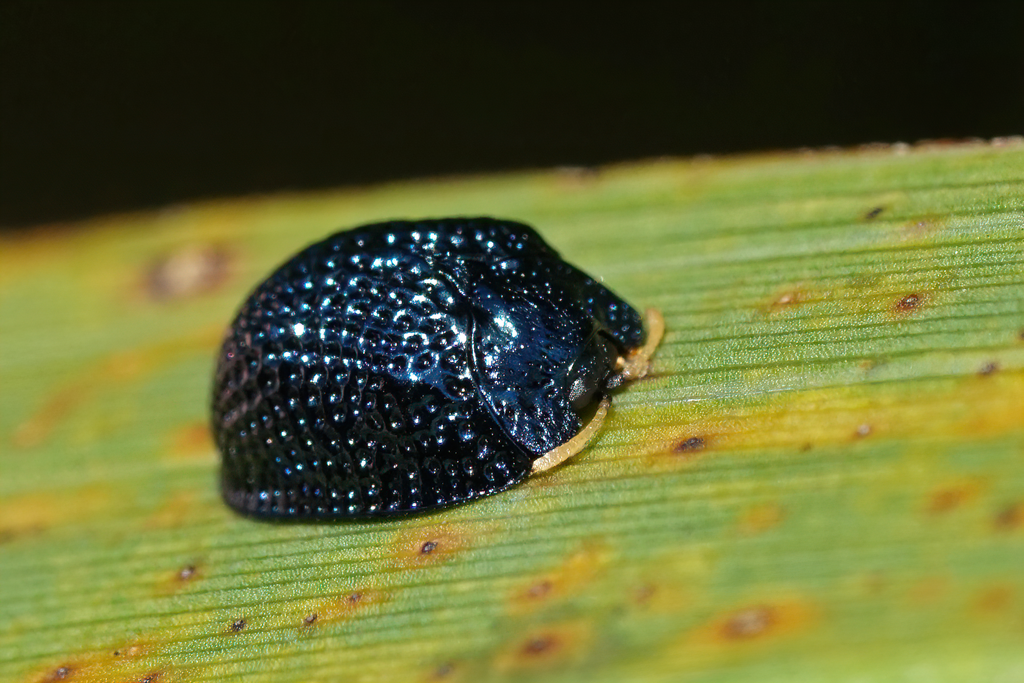
Palmetto tortoise beetles are tiny, metallic blue-purple beetles about 5 mm long with a rounded dome shape. They live on several Sabal palms in the southeastern United States, especially the native saw palmetto, and their larvae may chew leaf tissue.
Source: Wikipedia
How to recognize it
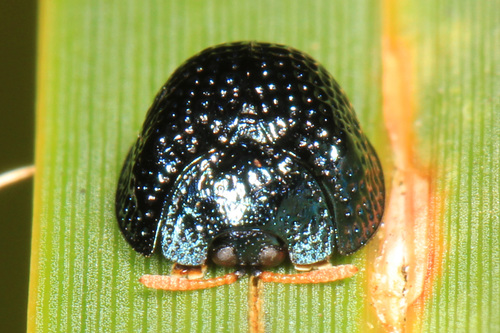
The beetle’s elytra and pronotum shine dark metallic blue or purple. Its body is shaped like a smooth half-sphere.
Source: Wikipedia
Size
Adults measure roughly 4.6 to 5.6 mm in length.
Source: Wikipedia
Is it a pest in the house?
It belongs to the leaf-beetle family Chrysomelidae. Larval feeding may damage leaves but rarely harms the overall tree.
Source: Wikipedia
Where it lives
It also lives on cabbage palm, dwarf palmetto, and scrub palmetto.
Source: Wikipedia
What it eats
Both larvae and adults feed on leaves of Sabal palms.
Source: Wikipedia
Life cycle
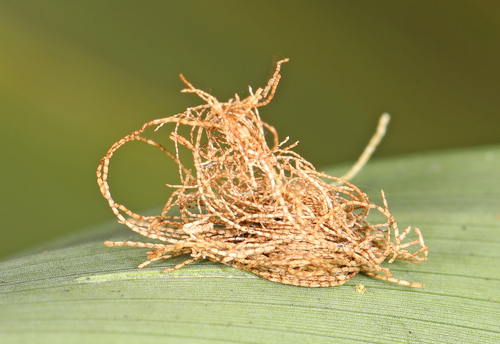
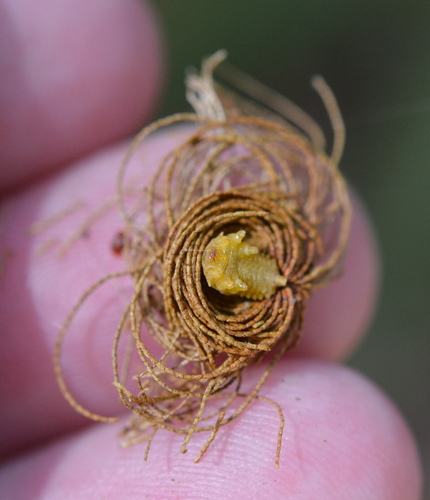
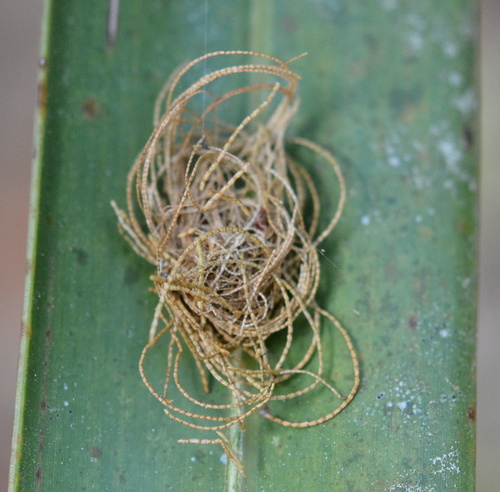
Females lay yellow, elongated eggs from March to mid-April. Maturing larvae cling to leaf surfaces and pupate beneath their own fecal thatch.
Source: Wikipedia
When you see it
Larvae and pupae appear in mid to late summer, while adults can be seen year-round.
Source: Wikipedia
Where it comes from
The species is native to the southeastern United States. Records include Florida, Georgia, Alabama, Texas, Louisiana and Mississippi.
Source: Wikipedia
Lookalikes
Also called the Florida tortoise beetle or iridescent blue chrysomelid beetle.
Source: Wikipedia
Where it is found in the US
Recorded in 6 of 51 states and DC. Most records: Florida, Georgia, South Carolina, Texas, Alabama, Mississippi.
Darker = more records. Counts are museum and citizen-science records, not population size.
Source: GBIF
Status: native in North America; native in United States. Source: iNaturalist
Months it is reported in the US
Source: GBIF
More photos
Questions people ask
Do the larvae damage palm trees?
Larvae chew leaf tissue and can cause leaf damage, but they rarely cause serious harm to the trees.
Source: Wikipedia
When are the eggs laid?
Females lay yellow, elongated eggs from March through mid-April.
Source: Wikipedia
Where can I find these beetles?
They are most common on saw palmetto and also occur on cabbage, dwarf, and scrub palmettos in the southeastern United States.
Source: Wikipedia
Same family (Chrysomelidae)
 Spotted Cucumber BeetleDiabrotica undecimpunctataDamages trees, gardens or crops
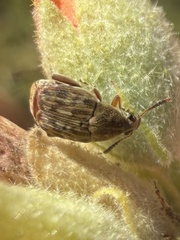 Bean WeevilAcanthoscelides obtectusDamages trees, gardens or crops
 Cowpea WeevilCallosobruchus maculatusDamages trees, gardens or crops
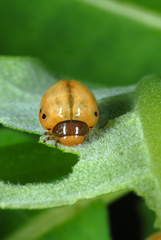 Swamp Milkweed Leaf BeetleLabidomera clivicollisDamages trees, gardens or crops
 Alder Leaf BeetleAgelastica alniDamages trees, gardens or crops
 Dogbane Leaf BeetleChrysochus auratus
Sources
- Wikipedia: https://en.wikipedia.org/wiki/Hemisphaerota_cyanea
Look it up elsewhere: GBIF · iNaturalist · BugGuide · ITIS · Wikipedia
Text written 2026-10-23 from the sources above and checked sentence by sentence against them. Data fetched 2026-10-23.