 Bug FAQ
Painted Wedge
Pyrgotis plagiatana · Order: Lepidoptera · Family: Tortricidae


The adult moth has a wingspan of about 18 mm and shows very variable wing colours and patterns, often with a distinctive V-shaped dark marking on the forewings. It lives in native scrub and forest from coastal areas up to sub-alpine zones in New Zealand, where adults are most often seen flying from September to June but can appear year-round. Larvae feed inside silk shelters they build between leaves of many host plants, chewing holes in the foliage, and later pupate in a thin cocoon within the same shelter.
Source: Wikipedia
How to recognize it
Forewings are triangular with a sharp tip, creamy-white background, and variable yellow-brown or pink-brown markings, including a dark V-shaped band and a large oval patch near the tornus; hind-wings are white, sometimes tinged ochreous and speckled with grey.
Source: Wikipedia
Size
Adults have a wingspan of about 18 mm.
Source: Wikipedia
What it eats
Larvae live in silk galleries between leaves of many host plants and chew numerous holes in the foliage.
Source: Wikipedia
Life cycle
Larvae pupate inside their leaf shelters, enclosed in a thin silken cocoon.
Source: Wikipedia
When you see it
Adults are most commonly on the wing from September to June but may be seen throughout the year.
Source: Wikipedia
Where it comes from
It is endemic to New Zealand.
Source: Wikipedia
Lookalikes
The species is highly variable; colour intensity and wing shape can change with exposure, making identification tricky.
Source: Wikipedia
More photos


Same family (Tortricidae)
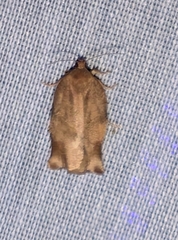 Oblique-banded Leafroller MothChoristoneura rosaceanaDamages trees, gardens or crops
 Garden TortrixClepsis peritanaDamages trees, gardens or crops
 Common MarbleSyricoris lacunanaDamages trees, gardens or crops
 Red-banded Leafroller MothArgyrotaenia velutinanaDamages trees, gardens or crops
 Light Brown Apple MothEpiphyas postvittanaDamages trees, gardens or crops
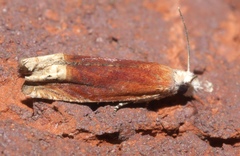 Aster and Reddish Eucosma Moths and AlliesEucosma parmatana
Sources
- Wikipedia: https://en.wikipedia.org/wiki/Pyrgotis_plagiatana
Look it up elsewhere: GBIF · iNaturalist · BugGuide · Wikipedia
Text written 2026-10-23 from the sources above and checked sentence by sentence against them. Data fetched 2026-10-23.