 Bug FAQ
Oak Bush-cricket
Meconema thalassinum · Order: Orthoptera · Family: Tettigoniidae
Also called: Drumming Katydid
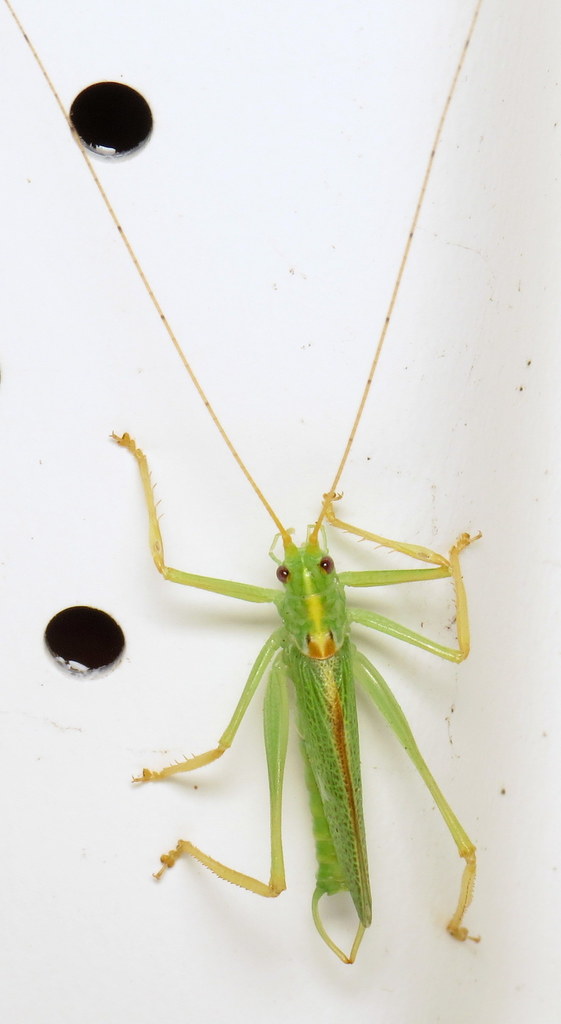
The oak bush-cricket is a small insect about 2 cm long, with antennae that can be twice as long. Unlike most bush-crickets it is carnivorous, feeding on small invertebrates, and females lay single eggs under bark; nymphs appear in late spring and mature by late summer.
Source: Wikipedia
Size
Adults reach about 20 mm in length, not counting the long ovipositor of females, and their antennae may extend another 40 mm.
Source: Wikipedia
Where it lives
They are found in the foliage of trees, especially oaks.
Source: Wikipedia
What it eats
This bush-cricket is carnivorous and eats smaller invertebrates such as larvae and caterpillars.
Source: Wikipedia
Life cycle
Females lay single eggs under tree bark. Nymphs emerge in late spring and become adults by late summer.
Source: Wikipedia
Where it is found in the US
Recorded in 20 of 51 states and DC. Most records: New York, Massachusetts, Washington, Pennsylvania, Michigan, Oregon, Maine, Connecticut.
Darker = more records. Counts are museum and citizen-science records, not population size.
Source: GBIF
Status: introduced in United States; introduced in Canada. Source: iNaturalist
Months it is reported in the US
Source: GBIF
More photos


Same family (Tettigoniidae)
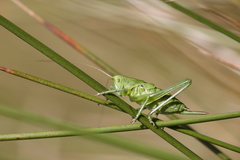 Great Green Bush-cricketTettigonia viridissimaCan bite
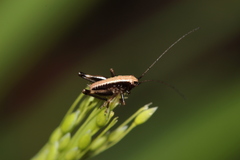 Dark Bush-cricketPholidoptera griseoaptera
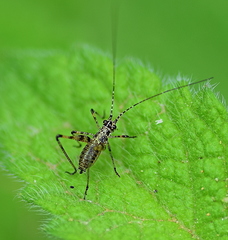 Mediterranean KatydidPhaneroptera nanaDamages trees, gardens or crops
 Fork-tailed Bush KatydidScudderia furcataDamages trees, gardens or crops
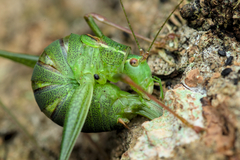 Speckled Bush-cricketLeptophyes punctatissima
 Roesel's Bush-cricketRoeseliana roeselii
Sources
- Wikipedia: https://en.wikipedia.org/wiki/Meconema_thalassinum
Look it up elsewhere: GBIF · iNaturalist · BugGuide · ITIS · Wikipedia
Text written 2026-10-22 from the sources above and checked sentence by sentence against them. Data fetched 2026-10-22.