 Bug FAQ
Northern Cloudywing
Thorybes pylades · Order: Lepidoptera · Family: Hesperiidae

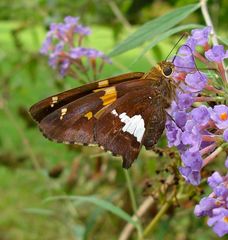
The northern cloudywing has a wingspan of about 32 to 47 mm. Both sexes have dark brown wings with small triangular clear spots. Adults fly from May to July in the north (one brood) and from March to September in the south (two broods).
Source: Wikipedia
How to recognize it
Both males and females have dark brown wings marked only by small triangular clear spots.
Source: Wikipedia
Size
The wingspan ranges between 32 and 47 mm.
Source: Wikipedia
Life cycle
Females lay single eggs under the leaves of their host plants.
Source: Wikipedia
When you see it
In the north they fly May-July with one brood; in the south they fly March-September with two broods.
Source: Wikipedia
Where it is found in the US
Recorded in 47 of 51 states and DC. Most records: Vermont, Arizona, New Mexico, Texas, California, South Carolina, Michigan, Ohio.
Darker = more records. Counts are museum and citizen-science records, not population size.
Source: GBIF
Months it is reported in the US
Source: GBIF
More photos

Questions people ask
What do northern cloudywings look like?
They have completely dark brown wings with small triangular clear spots.
Source: Wikipedia
When are they active?
In the north they fly from May to July with one generation; in the south they fly from March to September with two generations.
Source: Wikipedia
Same family (Hesperiidae)




Sources
- Wikipedia: https://en.wikipedia.org/wiki/Thorybes_pylades
Look it up elsewhere: GBIF · BugGuide · Wikipedia
Text written 2026-10-23 from the sources above and checked sentence by sentence against them. Data fetched 2026-10-23.