 Bug FAQ
Northeastern Sweat Bee
Augochloropsis viridula · Order: Hymenoptera · Family: Halictidae
Also called: Metallic Epauletted-Sweat Bee

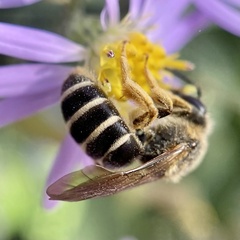
The northeastern sweat bee lives in the Midwestern United States and Canada, where it often occurs alongside a similar metallic-colored sweat bee. Its fringe hairs are about the same length as the hairs on its metasoma, and the segments of its abdomen are spaced two to four puncture widths apart.
Source: Wikipedia
How to recognize it
Fringe hairs are roughly the same length as metasomal hairs, and the abdominal terga are separated by two to four puncture widths.
Source: Wikipedia
Where it lives
It is mainly found in the Midwestern United States and Canada.
Source: Wikipedia
Where it comes from
Its primary range includes the Midwestern United States and Canada.
Source: Wikipedia
Where it is found in the US
Recorded in 33 of 51 states and DC. Most records: West Virginia, Vermont, Maryland, Massachusetts, Connecticut, New Hampshire, New York, Pennsylvania.
Darker = more records. Counts are museum and citizen-science records, not population size.
Source: GBIF
Status: native in North America; native in United States; native in Canada. Source: iNaturalist
Months it is reported in the US
Source: GBIF
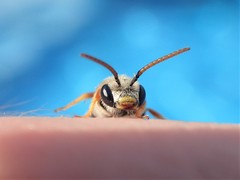
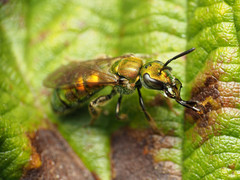
More photos
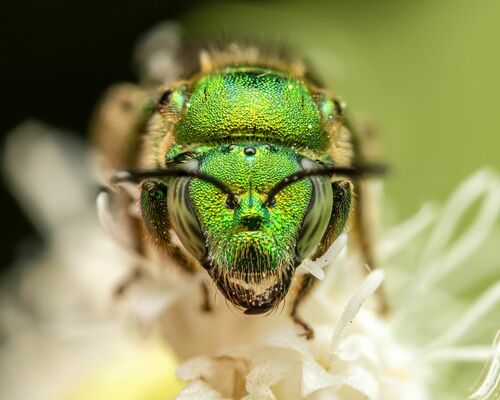
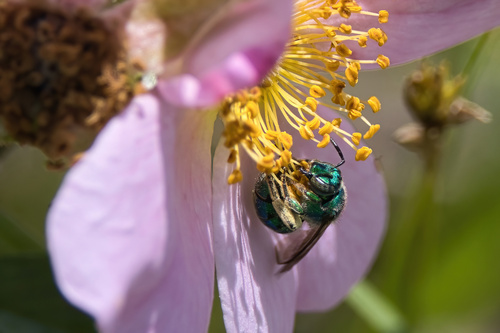
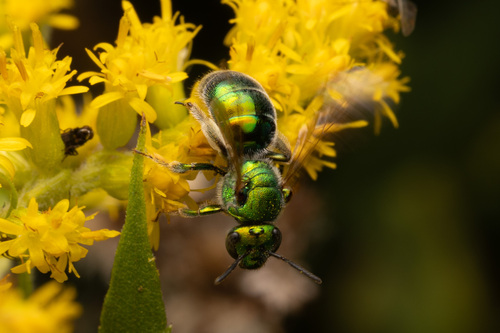
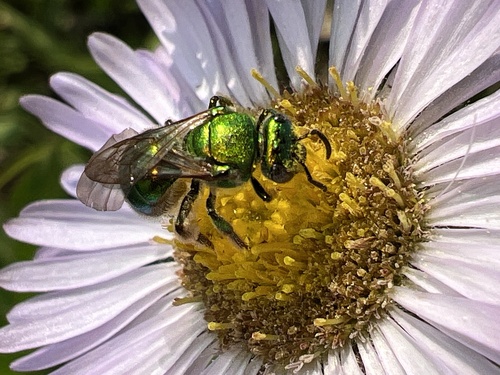
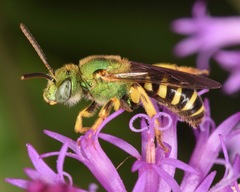
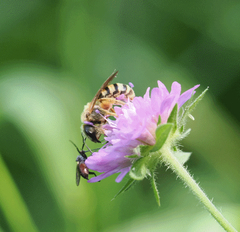
Same family (Halictidae)

Sources
- Wikipedia: https://en.wikipedia.org/wiki/Augochloropsis_viridula
Look it up elsewhere: GBIF · iNaturalist · BugGuide · ITIS · Wikipedia
Text written 2026-10-24 from the sources above and checked sentence by sentence against them. Data fetched 2026-10-24.