 Bug FAQ
Mottled Sand Grasshopper
Spharagemon collare · Order: Orthoptera · Family: Acrididae
Also called: Mottled Sand Locust
Source: Wikipedia
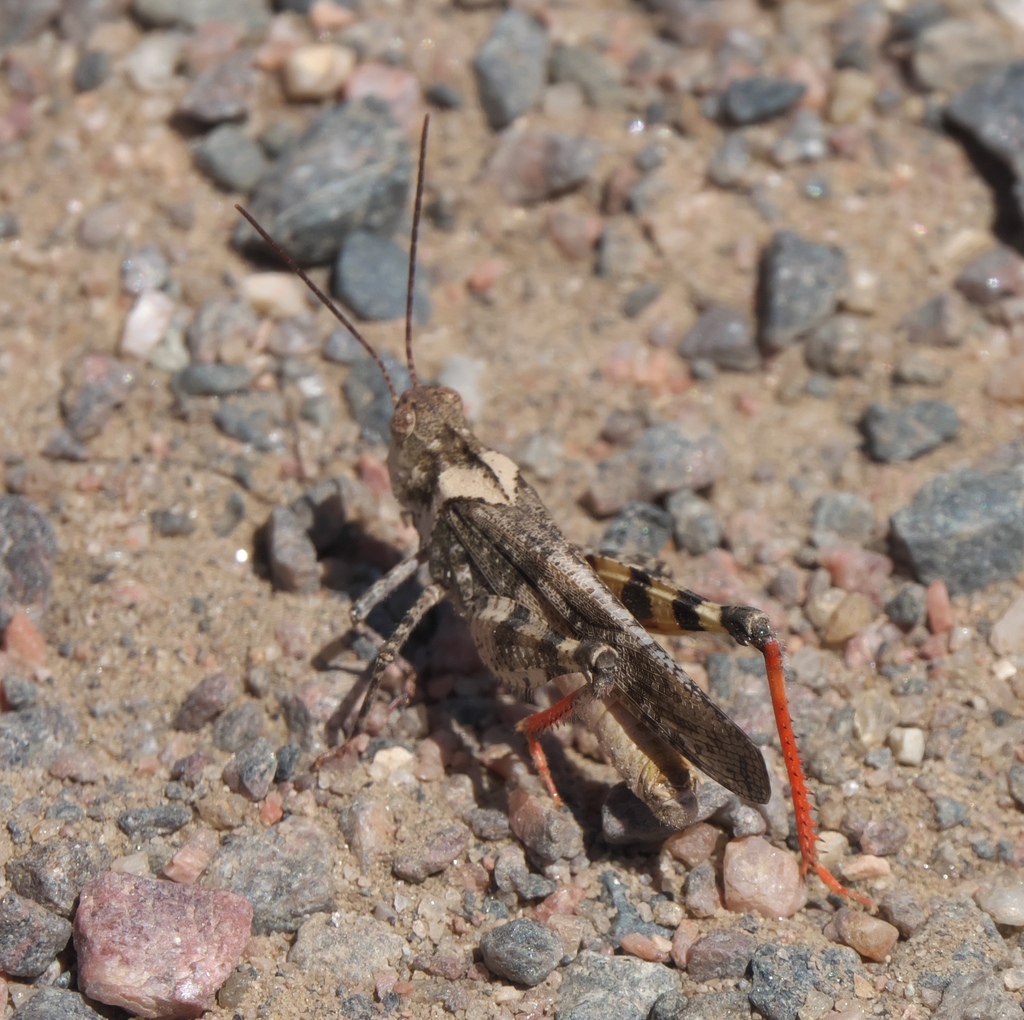
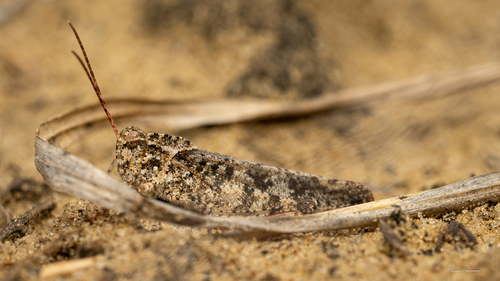
Adult mottled sand grasshoppers are tan with dark speckles, orange-red rear tibiae and yellow femora marked by four dark bands. Females reach 27 to 37 mm, males 23 to 31 mm, and they have a distinctive collar-like ridge behind the head. They live on loose sandy soils, especially at the edges of wheat fields, and are found in the northern and western US and southern Canada.
Source: Wikipedia
How to recognize it
Their bodies range from light to dark tan with dark speckles that may form bands, and the rear tibia is orange or red while the inner femur is yellow with four darker bands.
Source: Wikipedia
Size
Females are larger, measuring 27 to 37 mm, whereas males are 23 to 31 mm long to the end of the forewings. A pronounced pronotal ridge behind the head looks like a collar.
Source: Wikipedia
Is it a pest in the house?
They are considered a minor pest of wheat, though populations rarely cause noticeable damage.
Source: Wikipedia
Where it lives
They prefer loose, sandy soil and are especially common along the borders of wheat fields.
Source: Wikipedia
What it eats
They are herbivores that eat a variety of grasses, sedges and forbs, feeding on the ground.
Source: Wikipedia
Life cycle
Mating takes place in May, with nymphs hatching at the end of May or early June. All five instar stages can be present together because hatching occurs over an extended period.
Source: Wikipedia
When you see it
Adults are seen from July through September, taking shade breaks during the hottest part of the day and resuming activity at dusk.
Source: Wikipedia
Where it comes from
They occur in the northern and western United States and in southern Canada.
Source: Wikipedia
Where it is found in the US
Recorded in 38 of 51 states and DC. Most records: Colorado, Michigan, Florida, North Dakota, Oklahoma, Illinois, Nebraska, Idaho.
Darker = more records. Counts are museum and citizen-science records, not population size.
Source: GBIF
Status: native in North America; native in Canada; native in United States. Source: iNaturalist
Months it is reported in the US
Source: GBIF
More photos
Questions people ask
Is the mottled sand grasshopper a pest of wheat?
Yes, it can be a minor pest of wheat crops, though it usually does not cause serious damage.
Source: Wikipedia
When can I expect to see adult mottled sand grasshoppers?
Adults are active from July to September, resting in shade during the hottest hours and becoming active again at dusk.
Source: Wikipedia
What do mottled sand grasshoppers look like?
They are tan with dark speckles, have orange-red rear tibiae, and yellow femora marked with four dark bands; females are larger than males.
Source: Wikipedia
Same family (Acrididae)
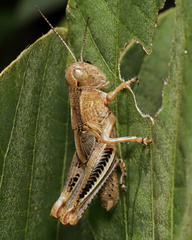 Differential GrasshopperMelanoplus differentialisDamages trees, gardens or crops
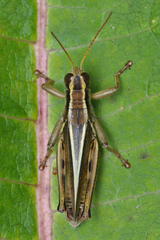 Two-striped GrasshopperMelanoplus bivittatusDamages trees, gardens or crops
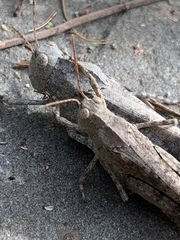 Carolina GrasshopperDissosteira carolinaDamages trees, gardens or crops
 Common Field GrasshopperChorthippus brunneus
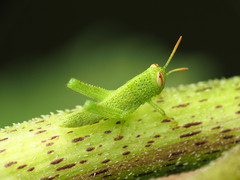 Egyptian Bird GrasshopperAnacridium aegyptium
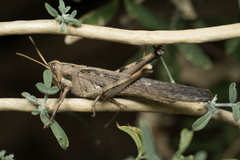 Gray Bird GrasshopperSchistocerca nitensDamages trees, gardens or crops
Sources
- Wikipedia: https://en.wikipedia.org/wiki/Spharagemon_collare
Look it up elsewhere: GBIF · iNaturalist · BugGuide · ITIS · Wikipedia
Text written 2026-10-23 from the sources above and checked sentence by sentence against them. Data fetched 2026-10-23.