 Bug FAQ
Mormon Cricket
Anabrus simplex · Order: Orthoptera · Family: Tettigoniidae
Source: Wikipedia
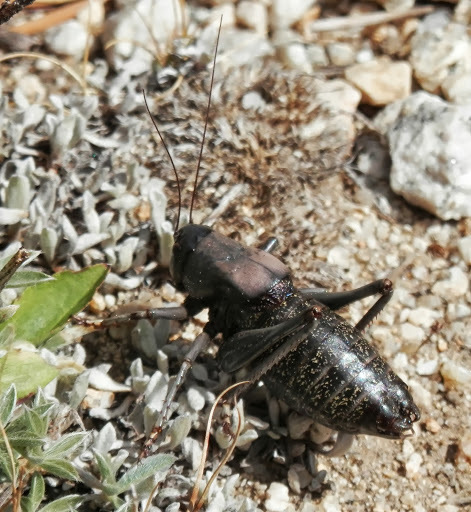
These insects can grow to almost 8 cm (3 in) long and show many colors such as black, brown, red, purple or green. In swarms they travel up to two kilometres a day and may become serious agricultural pests.
Source: Wikipedia
How to recognize it
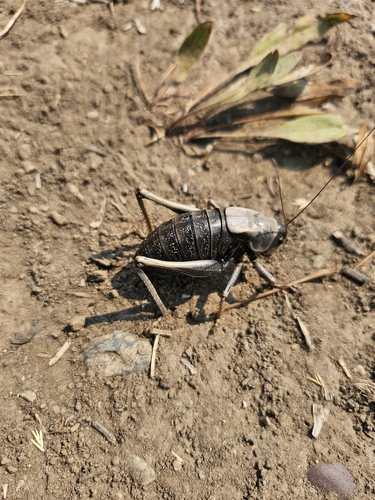
The abdomen can show striped patterns.
Source: Wikipedia
Size
Adults can reach nearly 8 cm (about 3 in) in length.
Source: Wikipedia
Is it a pest in the house?
During swarming they can travel up to two kilometres a day and become a serious agricultural pest and traffic hazard. The most common chemical control is carbaryl bait, sold as Sevin Dust.
Source: Wikipedia
Does it bite or sting?
Females have a long ovipositor for laying eggs, which should not be confused with a stinger. No predators specialize on them, likely because of their migratory habits and large population swings.
Source: Wikipedia
How to get rid of it
Carbaryl bait (Sevin Dust) is the most widely used chemical method. A fungal biopesticide based on Nosema locustae is another control option.
Source: Wikipedia
What it eats
They prefer to eat herbaceous plants, especially forbs, but will also consume grasses and shrubs like sagebrush. They are opportunistic predators, eating other insects including injured or dead Mormon crickets.
Source: Wikipedia
Life cycle
Eggs usually hatch in spring, though in some places they may remain dormant for up to five years. Nymphs pass through seven growth stages and become adults in about two to three months.
Source: Wikipedia
When you see it
Hatching mainly occurs in spring, though timing can vary by region.
Source: Wikipedia
Lookalikes
They belong to the shield-backed katydid subfamily (Tettigoniidae), a group also called katydids or bush crickets. The name “Mormon cricket” is misleading; true crickets are in the Gryllidae family.
Source: Wikipedia
Where it is found in the US
Recorded in 19 of 51 states and DC. Most records: Colorado, Idaho, Nevada, Wyoming, Utah, California, Montana, Oregon.
Darker = more records. Counts are museum and citizen-science records, not population size.
Source: GBIF
Status: native in North America; native in Canada; native in United States. Source: iNaturalist
Months it is reported in the US
Source: GBIF
More photos
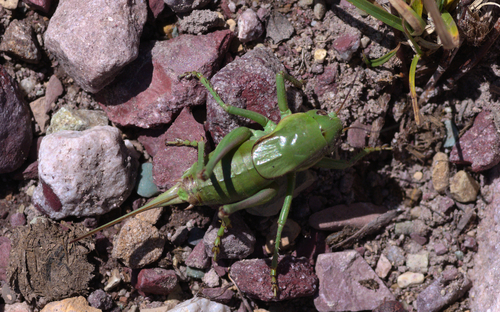
Questions people ask
What do Mormon crickets eat?
They mainly feed on herbaceous plants such as forbs, grasses and shrubs like sagebrush, and will also eat other insects.
Source: Wikipedia
How can I control a Mormon cricket infestation?
Apply carbaryl bait (Sevin Dust) or use a Nosema locustae-based biopesticide to reduce their numbers.
Source: Wikipedia
Do Mormon crickets bite or sting?
Females have a long egg-laying tube at the tail end. It looks like a stinger, but it is not one.
Source: Wikipedia
Same family (Tettigoniidae)
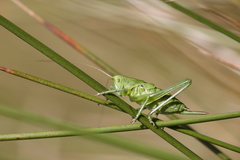 Great Green Bush-cricketTettigonia viridissimaCan bite
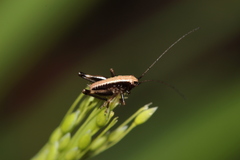 Dark Bush-cricketPholidoptera griseoaptera
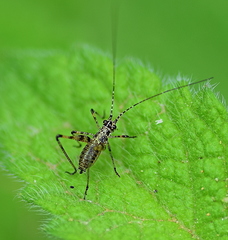 Mediterranean KatydidPhaneroptera nanaDamages trees, gardens or crops
 Fork-tailed Bush KatydidScudderia furcataDamages trees, gardens or crops
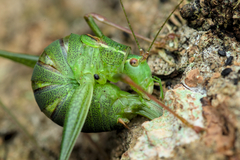 Speckled Bush-cricketLeptophyes punctatissima
 Roesel's Bush-cricketRoeseliana roeselii
Sources
- Wikipedia: https://en.wikipedia.org/wiki/Mormon_cricket
Look it up elsewhere: GBIF · iNaturalist · BugGuide · ITIS · Wikipedia
Text written 2026-10-22 from the sources above and checked sentence by sentence against them. Data fetched 2026-10-22.