 Bug FAQ
Migratory Locust
Locusta migratoria · Order: Orthoptera · Family: Acrididae
Also called: Locust, Tropical Migratory Locust
Source: Wikipedia

Adult migratory locusts are 40 to 60 mm long and change colour and size depending on whether they are solitary or gregarious. They live across Africa, Europe, Asia, Australia and New Zealand, becoming plague-level in dry regions. A single locust can eat its own weight in fresh food each day, and a million locusts can consume a ton of food, making them serious crop pests.
Source: Wikipedia
How to recognize it
Gregarious nymphs are yellow-orange with black spots, while solitary nymphs are green or brown. Gregarious adults are brownish with yellow that intensifies as they mature; solitary adults are brown with varying green depending on vegetation.
Source: Wikipedia
Size
Gregarious adults measure 40 to 60 mm, with males and females differing in size; they are smaller than solitary adults.
Source: Wikipedia
How to get rid of it
National agriculture ministries run locust survey and control, often with help from the FAO.
Where it lives
It reaches plague levels in dry areas but stays solitary in northern Australian savannas.
Source: Wikipedia
What it eats
An adult can consume its own weight in fresh food each day. A million locusts eat about one ton of food.
Source: Wikipedia
Life cycle
The migratory locust switches between solitary and gregarious phases depending on population density. Its colour and size vary with phase and age.
Source: Wikipedia
Where it comes from
Its native range includes Africa, Europe, Asia, Australia and New Zealand.
Source: Wikipedia
Lookalikes
Many other grasshopper species that gather in groups are also called locusts, including the desert locust.
More photos

Questions people ask
How much damage can they do to crops?
A single locust can eat its own weight daily, and a million locusts can consume a ton of food, so large swarms can devastate crops.
Source: Wikipedia
Same family (Acrididae)
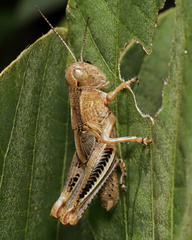 Differential GrasshopperMelanoplus differentialisDamages trees, gardens or crops
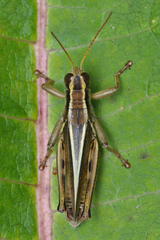 Two-striped GrasshopperMelanoplus bivittatusDamages trees, gardens or crops
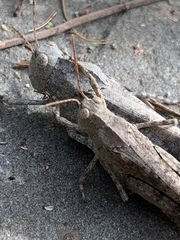 Carolina GrasshopperDissosteira carolinaDamages trees, gardens or crops
 Common Field GrasshopperChorthippus brunneus
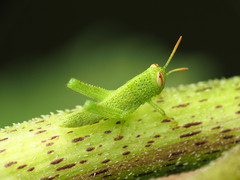 Egyptian Bird GrasshopperAnacridium aegyptium
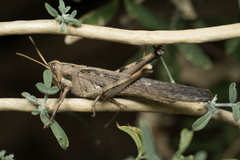 Gray Bird GrasshopperSchistocerca nitensDamages trees, gardens or crops
Sources
Look it up elsewhere: GBIF · iNaturalist · BugGuide · Wikipedia
Text written 2026-10-22 from the sources above and checked sentence by sentence against them. Data fetched 2026-10-22.