 Bug FAQ
Mexican Sootywing
Pholisora mejicanus · Order: Lepidoptera · Family: Hesperiidae
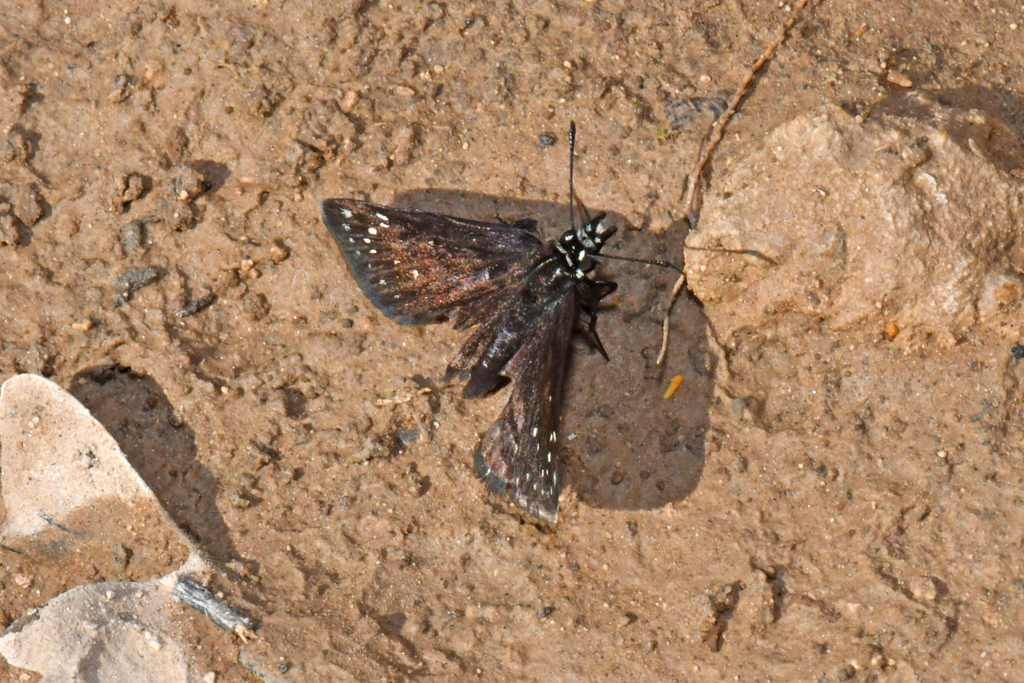
Mexican sootywings are small to medium-sized skippers with stout bodies.
Source: Wikipedia
How to recognize it
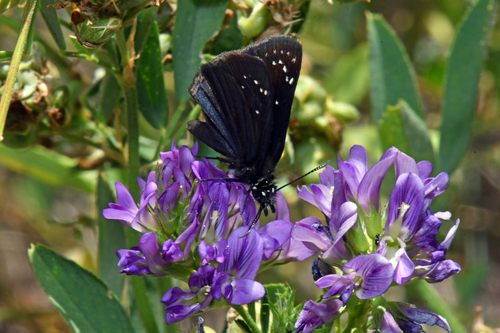
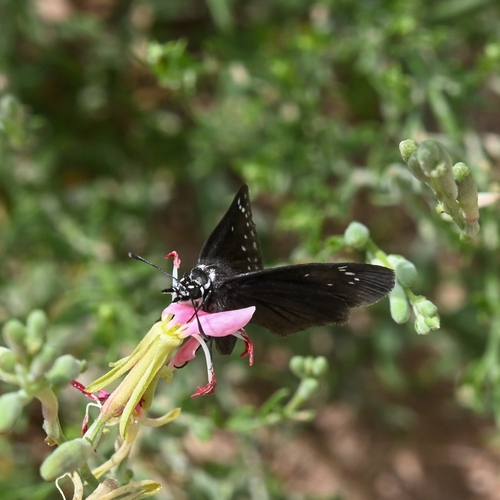
From above they appear as black skippers with a distinctive pattern of white dots. Viewed from the side, the underside of the hindwing is blue-gray with contrasting black veins. The blue-gray hindwing underside with black veins is a more reliable ID feature than the wing-top dot pattern.
Source: Wikipedia
Size
Their bodies are stout and range from small to medium size compared with other butterflies.
Source: Wikipedia
What it eats
Caterpillars feed on plants in the amaranth family, specifically amaranths and Chenopodium species.
Source: Wikipedia
Life cycle
Mexican sootywing is a butterfly belonging to the skipper family Hesperiidae.
Source: Wikipedia
Where it comes from
The species occurs in the southwestern United States and extends south throughout most of Mexico.
Source: Wikipedia
Lookalikes
Its range overlaps with the common sootywing, a similar-looking species. It can be distinguished by the blue-gray underside of the hindwing with black veins.
Source: Wikipedia
Where it is found in the US
Recorded in 6 of 51 states and DC. Most records: New Mexico, Colorado, California, Texas, Nevada, Arizona.
Darker = more records. Counts are museum and citizen-science records, not population size.
Source: GBIF
Months it is reported in the US
Source: GBIF
More photos
Questions people ask
How can I tell a Mexican sootywing from a common sootywing?
Check the underside of the hindwing; Mexican sootywings have a blue-gray color with contrasting black veins, which is not typical of the common sootywing.
Source: Wikipedia
Same family (Hesperiidae)




Sources
- Wikipedia: https://en.wikipedia.org/wiki/Pholisora_mejicanus
Look it up elsewhere: GBIF · iNaturalist · BugGuide · ITIS · Wikipedia
Text written 2026-10-28 from the sources above and checked sentence by sentence against them. Data fetched 2026-10-28.