 Bug FAQ
Cassin's 17-year cicada
Magicicada cassini · Order: Hemiptera · Family: Cicadidae
Also called: dwarf periodical cicada, Cassini Periodical Cicada
Source: Wikipedia

Adult cassini cicadas are 24 to 27 mm long, black with orange legs and translucent wings marked with orange veins (size, id_marks). They emerge every 17 years (sometimes 13 to 21 years) and feed on tree sap, while nymphs live on roots for many years (life_cycle, diet). Females cut slits in twigs to lay eggs, which can cause shoots to droop and damage young trees (household_pest).
Source: Wikipedia
How to recognize it
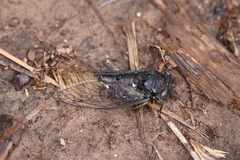
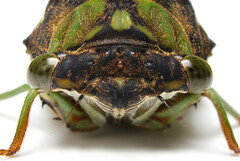
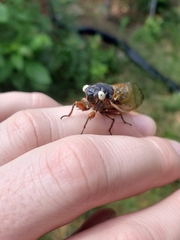
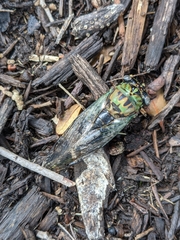
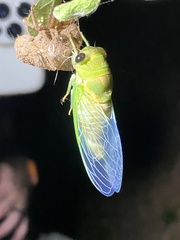
The head and pronotum are black with a narrow orange edge, eyes are large and red, and the abdomen is black (id_marks). Legs are orange and the wings are clear with orange veins and darker tips (id_marks).
Source: Wikipedia
Size
Adults measure about 24 to 27 mm from head to wing tip (size).
Source: Wikipedia
Is it a pest in the house?
In outbreak years they can heavily damage trees, especially young saplings (household_pest). Egg-laying cuts cause twigs to droop and lose leaves (household_pest).
Source: Wikipedia
Where it lives
They are found across the northern United States and southern Canada (habitat). After mating, females insert their ovipositors into shoots to lay eggs (habitat).
Source: Wikipedia
What it eats
Adults feed on sap from trees and shrubs (diet). Nymphs grow slowly, molting five times while feeding on deeper roots over about 17 years (diet).
Source: Wikipedia
Life cycle
They have a 17-year life cycle, similar to the 13-year Magicicada tredecassini (life_cycle). Nymphs molt five times as they move to larger roots during their underground development (life_cycle). Their cycle can vary from 13 to 21 years (life_cycle).
Source: Wikipedia
When you see it
The most recent emergence of Brood X was in May-June 2021 across many eastern states (season).
Source: Wikipedia
Where it comes from
Magicicada cassini is native to North America, ranging across the northern US belt and southern Canada (native_range).
Source: Wikipedia
Lookalikes
They are indistinguishable from the 13-year Magicicada tredecassini (lookalikes). Both species are grouped as cassini-type periodical cicadas (lookalikes).
Source: Wikipedia
Where it is found in the US
Recorded in 23 of 51 states and DC. Most records: Illinois, Maryland, Ohio, Kentucky, Virginia, Indiana, Kansas, Tennessee.
Darker = more records. Counts are museum and citizen-science records, not population size.
Source: GBIF
Months it is reported in the US
Source: GBIF
More photos


Questions people ask
What do cassini cicadas look like?
They have a black head and body, red eyes, orange legs, and clear wings with orange veins and dark tips.
Source: Wikipedia
When do they appear?
They emerge in late spring, typically May to June, as seen in the 2021 Brood X emergence.
Source: Wikipedia
Do they damage trees?
Yes, females cut slits in twigs to lay eggs, which can cause shoots to droop and harm young trees.
Source: Wikipedia
Same family (Cicadidae)


Sources
- Wikipedia: https://en.wikipedia.org/wiki/Magicicada_cassini
Look it up elsewhere: GBIF · BugGuide · Wikipedia
Text written 2026-10-23 from the sources above and checked sentence by sentence against them. Data fetched 2026-10-23.