 Bug FAQ
Lychee Stink Bug
Lyramorpha rosea · Order: Hemiptera · Family: Tessaratomidae
Also called: Litchi Stink Bug
Source: Wikipedia

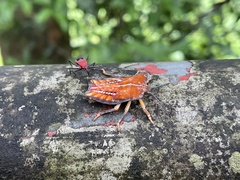
Adults are about 0.9 inches (2.3 cm) long. They have pink legs and antennae, bronze-coloured edges on the thorax and wings, and a greenish-yellow underside. They eat plants in the Sapindaceae family, including native trees such as Alectryon and the cultivated lychee.
Source: Wikipedia
Size
Body length is about 11 lines, which equals roughly 0.917 inches (2.328 cm).
Source: Wikipedia
Where it lives
It occurs in eastern Australia.
Source: Wikipedia
What it eats
It feeds on Sapindaceae plants, including genera Alectryon, Atalaya, Cupaniopsis, Guioa, and the exotic lychee.
Source: Wikipedia
Life cycle
Females guard clutches of up to 42 eggs until they hatch.
Source: Wikipedia
Where it comes from
Its native range is eastern Australia.
Source: Wikipedia
More photos


Questions people ask
What does the lychee stink bug look like?
It has pink legs and antennae, bronze edges on the thorax and wings, and a greenish-yellow underside.
Source: Wikipedia
What plants does it feed on?
It feeds on Sapindaceae trees such as Alectryon, Atalaya, Cupaniopsis, Guioa, and also on cultivated lychee.
Source: Wikipedia
Same family (Tessaratomidae)


Sources
- Wikipedia: https://en.wikipedia.org/wiki/Lyramorpha_rosea
Look it up elsewhere: GBIF · iNaturalist · BugGuide · ITIS · Wikipedia
Text written 2026-10-23 from the sources above and checked sentence by sentence against them. Data fetched 2026-10-22.