 Bug FAQ
Longleg Dandy
Portia schultzi · Order: Araneae · Family: Salticidae
Also called: Southern Dandy, Longleg Dandy Jumping Spider
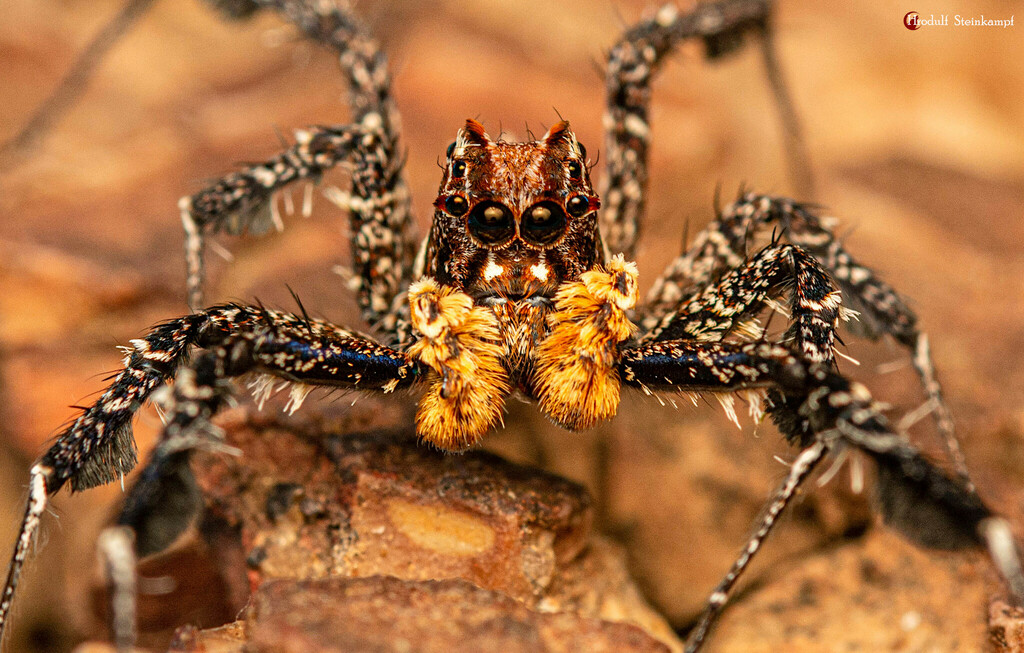
Females are 5 to 7 mm long and males 4 to 6 mm long. The spider has an orange-brown carapace with dark mottling and hairs, and males show white tufts on the thorax and a white band above the leg bases. It lives from South Africa up through Kenya, also in West Africa and Madagascar, and it prefers hunting other spiders, especially web-builders, then jumping spiders and insects.
Source: Wikipedia
How to recognize it
Both sexes have an orange-brown carapace with dark brown mottling and a covering of dark brown and whitish hairs. Males have noticeable white tufts on the thorax and a broad white band above the leg bases; females show these features less clearly.
Source: Wikipedia
Size
Female bodies measure 5 to 7 mm, while males are 4 to 6 mm long.
Source: Wikipedia
Does it bite or sting?
If it cannot maintain contact with prey, the prey may recover after a few minutes to an hour.
Source: Wikipedia
Where it lives
It has relatively longer legs than other Portia species and moves with a lolloping gait.
Source: Wikipedia
What it eats
It mainly preys on web-building spiders, then other jumping spiders, and finally insects. Its venom is especially potent against other spiders.
Source: Wikipedia
Life cycle
Females often try to kill and eat the male during or after mating, and subadult females mimic adult females to lure males as prey. Female contests are violent, and mating embraces usually last 20 to 60 seconds.
Source: Wikipedia
When you see it
It can focus on prey up to about 10 cm away in good light, but its vision is poor in dim light.
Source: Wikipedia
Where it comes from
Its distribution includes South Africa, Kenya, West Africa and Madagascar.
Source: Wikipedia
More photos


Questions people ask
How big does Longleg Dandy get?
Females are 5 to 7 mm long and males are 4 to 6 mm long.
Source: Wikipedia
What does it look like?
It has an orange-brown carapace with dark mottling and hairs; males show white tufts on the thorax and a white band above the legs.
Source: Wikipedia
Where is it found?
It occurs from South Africa to Kenya and also in West Africa and Madagascar.
Source: Wikipedia
What does it eat?
It prefers hunting web-building spiders, then other jumping spiders, and finally insects.
Source: Wikipedia
Same family (Salticidae)



Sources
- Wikipedia: https://en.wikipedia.org/wiki/Portia_schultzi
Look it up elsewhere: GBIF · iNaturalist · BugGuide · ITIS · Wikipedia
Text written 2026-10-23 from the sources above and checked sentence by sentence against them. Data fetched 2026-10-23.