 Bug FAQ
Long-winged Conehead
Conocephalus fuscus · Order: Orthoptera · Family: Tettigoniidae
Also called: Long-winged Cone-head

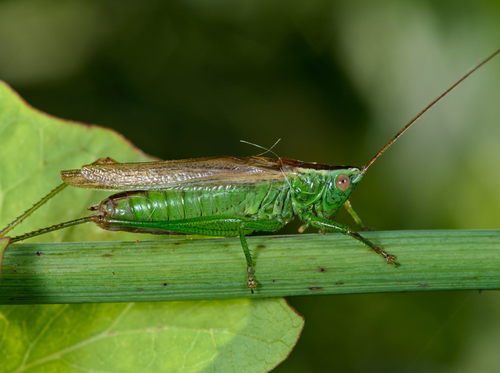
The long-winged conehead is a grass-green bush-cricket about 1.6 to 2.2 cm long, with brown wings that extend past the abdomen. It lives in grassy meadows and woodlands across the British Isles and parts of France, Italy and the Netherlands. Males and females have long antennae, large hind legs for jumping, and females use a straight ovipositor to lay eggs; wing form depends on population density.
Source: Wikipedia
How to recognize it
Adults are slender, grass-green with a dark brown stripe along the back that turns white near the thorax, and have brown wings and a reddish-brown abdomen.
Source: Wikipedia
Size
Mature individuals measure 16 to 22 mm in body length. Both hind and fore wings are longer than the abdomen and extend beyond it.
Source: Wikipedia
Where it lives
It inhabits grassy meadows, woodlands and dry areas where other bush-crickets are found.
Source: Wikipedia
Life cycle
The species shows wing polymorphism, with the wing form influenced by population density.
Source: Wikipedia
Where it comes from
Native to the British Isles, it also occurs in France, Italy and the Netherlands, with its strongest presence in the United Kingdom.
Source: Wikipedia
Lookalikes
In the British Isles it can be confused with the short-winged conehead, but the long-winged form has fully developed wings for flight.
Source: Wikipedia
Where it is found in the US
Recorded in 1 of 51 states and DC. Most records: Pennsylvania.
Darker = more records. Counts are museum and citizen-science records, not population size.
Source: GBIF
More photos
Questions people ask
Are they a pest inside the house?
They are not reported to damage buildings, food, or fabrics.
Source: Wikipedia
Can they damage garden plants?
The available information does not mention any damage to crops or garden vegetation.
Source: Wikipedia
Same family (Tettigoniidae)
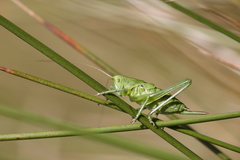 Great Green Bush-cricketTettigonia viridissimaCan bite
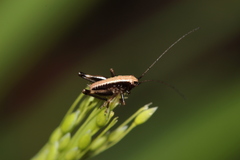 Dark Bush-cricketPholidoptera griseoaptera
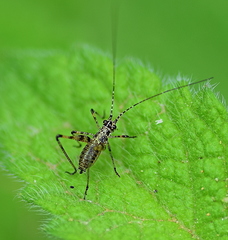 Mediterranean KatydidPhaneroptera nanaDamages trees, gardens or crops
 Fork-tailed Bush KatydidScudderia furcataDamages trees, gardens or crops
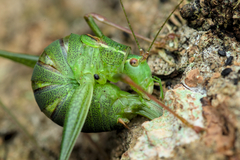 Speckled Bush-cricketLeptophyes punctatissima
 Roesel's Bush-cricketRoeseliana roeselii
Sources
- Wikipedia: https://en.wikipedia.org/wiki/Conocephalus_fuscus
Look it up elsewhere: GBIF · iNaturalist · BugGuide · Wikipedia
Text written 2026-10-22 from the sources above and checked sentence by sentence against them. Data fetched 2026-10-22.