 Bug FAQ
Lily Leaf Beetle
Lilioceris lilii · Order: Coleoptera · Family: Chrysomelidae
Also called: Lily Beetle, Red Lily Beetle, Scarlet Lily Beetle
Source: Wikipedia
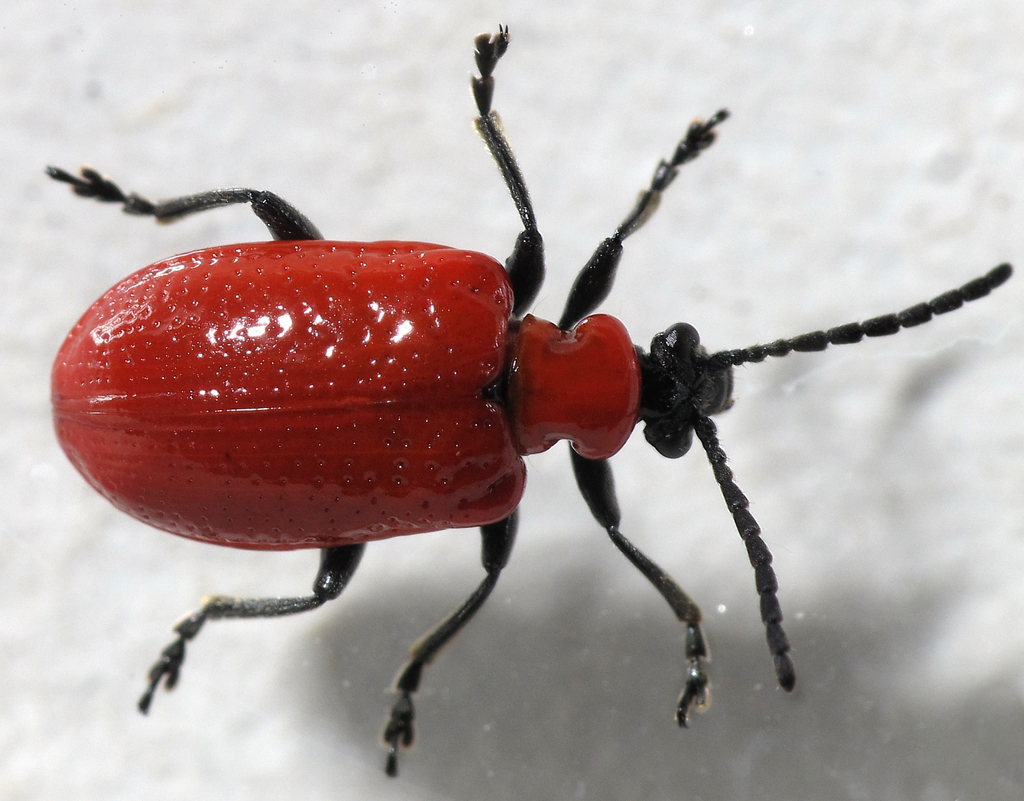
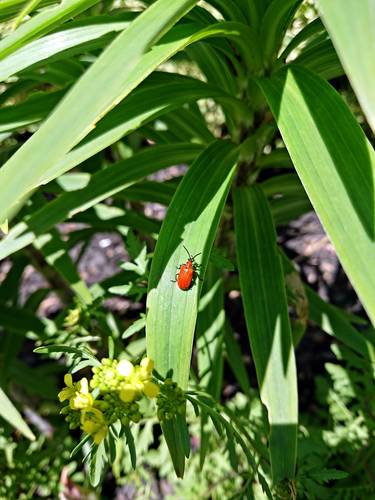
Adult lily leaf beetles are 6 to 9 mm long, bright scarlet on the wing covers and black underneath, with long legs and 11-segment antennae. Both adults and especially larvae eat leaves, stems, buds and flowers of lilies and related plants, often ruining ornamental gardens. Hand-picking eggs, larvae and adults or using registered leaf-beetle insecticides can keep populations under control.
Source: Wikipedia
How to recognize it
The beetle’s wing covers are shiny scarlet, while its underside, legs, head, eyes and antennae are black. Each antenna has 11 segments; the eyes are notched and the thorax shows two grooves.
Source: Wikipedia
Size
Adults measure about 6 to 9 mm (¼ to ⅜ inch) in length.
Source: Wikipedia
How to get rid of it
Regularly hand-picking and crushing eggs, larvae and adults works, though it is labor-intensive. Insecticides such as carbaryl, methoxychlor, malathion or rotenone, approved for leaf beetles, can help reduce numbers.
Source: Wikipedia
Where it lives
They overwinter in soil and emerge in early spring, preferring moist, cool places. The beetle is now a pest in many temperate regions where lilies are grown.
Source: Wikipedia
What it eats
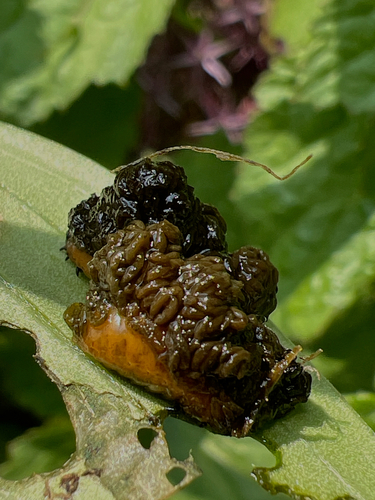
Larvae start feeding under a leaf and move upward, causing the most damage over a 24-day period.
Source: Wikipedia
When you see it
Adults appear in spring to feed and mate, and females can lay up to 450 eggs per season in batches of about 12 on leaf undersides.
Source: Wikipedia
Where it comes from
Originally from parts of Europe and Asia, it reached North America around 1943 via imported bulbs.
Source: Wikipedia
Lookalikes
It can be mistaken for the cardinal beetle, which also has red wing covers and a black underside.
Source: Wikipedia
Where it is found in the US
Recorded in 22 of 51 states and DC. Most records: New York, Michigan, Vermont, Massachusetts, Minnesota, Wisconsin, New Jersey, Pennsylvania.
Darker = more records. Counts are museum and citizen-science records, not population size.
Source: GBIF
Status: introduced in United States; introduced in Canada. Source: iNaturalist
Months it is reported in the US
Source: GBIF
More photos
Questions people ask
How can I get rid of them in my garden?
Pick off eggs, larvae and adults by hand, or use approved leaf-beetle insecticides such as carbaryl or malathion.
Source: Wikipedia
Same family (Chrysomelidae)
 Spotted Cucumber BeetleDiabrotica undecimpunctataDamages trees, gardens or crops
 Bean WeevilAcanthoscelides obtectusDamages trees, gardens or crops
 Cowpea WeevilCallosobruchus maculatusDamages trees, gardens or crops
 Swamp Milkweed Leaf BeetleLabidomera clivicollisDamages trees, gardens or crops
 Alder Leaf BeetleAgelastica alniDamages trees, gardens or crops
 Dogbane Leaf BeetleChrysochus auratus
Sources
- Wikipedia: https://en.wikipedia.org/wiki/Scarlet_lily_beetle
Look it up elsewhere: GBIF · iNaturalist · BugGuide · ITIS · Wikipedia
Text written 2026-10-22 from the sources above and checked sentence by sentence against them. Data fetched 2026-10-22.