 Bug FAQ
Large Marsh Grasshopper
Stethophyma grossum · Order: Orthoptera · Family: Acrididae
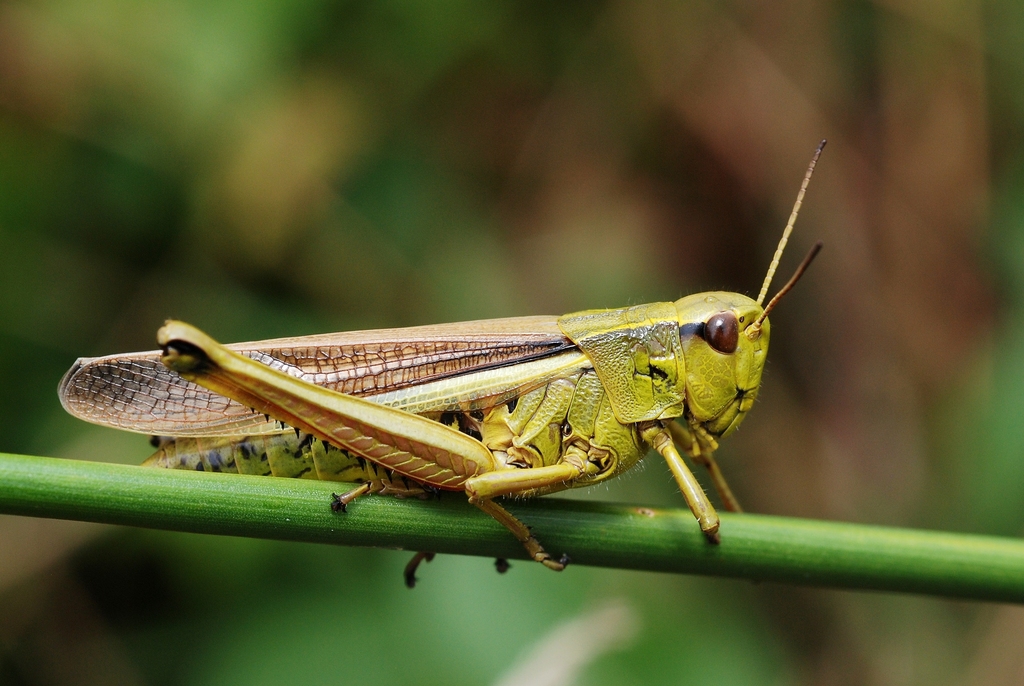
The large marsh grasshopper is a fairly big grasshopper; females are about 26 to 39 mm long and males 12 to 25 mm. It is usually olive-brown to greenish-yellow, sometimes with purple, and has a black stripe behind each eye with a pale line reaching the wing edges. It lives in wet meadows and marshes, especially in quaking sphagnum moss bogs in southern England.
Source: Wikipedia
How to recognize it
Most have olive-brown to greenish-yellow bodies, though some show purple tones. A black stripe runs behind each eye and a pale line extends to the upper wing edges.
Source: Wikipedia
Size
Females reach 25.9 to 39.1 mm in body length, while males are smaller at 11.8 to 25 mm.
Source: Wikipedia
Where it lives
Typical habitats are wet meadows and marshes across its range.
Source: Wikipedia
What it eats
After mating, females lay elongated egg pods at the bases of grass tussocks, each pod holding up to 14 eggs.
Source: Wikipedia
Life cycle
The species completes its life cycle in one year; eggs overwinter and hatch as nymphs from late May.
Source: Wikipedia
When you see it
Adults appear from late July or early August and remain until late September or October.
Source: Wikipedia
Where it comes from
It occurs throughout Europe and has a few records from western Asia.
Source: Wikipedia
Where it is found in the US
Recorded in 1 of 51 states and DC. Most records: Alaska.
Darker = more records. Counts are museum and citizen-science records, not population size.
Source: GBIF
Status: native in North America; native in United States. Source: iNaturalist
More photos
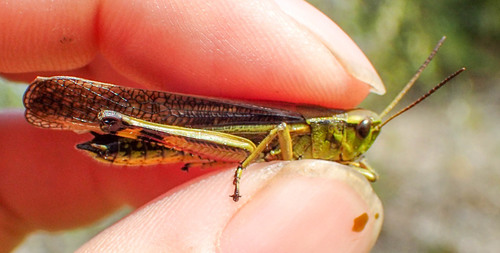
Questions people ask
When can I expect to see adult large marsh grasshoppers?
Adults show up in late July or early August and stay around until late September or October.
Source: Wikipedia
What habitats do they prefer?
They live in wet meadows and marshes, and in southern England they are especially common in quaking sphagnum moss bogs.
Source: Wikipedia
How big are they?
Females are about 26 to 39 mm long, while males range from roughly 12 to 25 mm.
Source: Wikipedia
How can I recognize them?
They are olive-brown to greenish-yellow, sometimes with purple, have a black stripe behind each eye and a pale line that runs to the wing edges.
Source: Wikipedia
Same family (Acrididae)
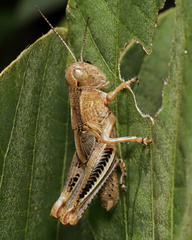 Differential GrasshopperMelanoplus differentialisDamages trees, gardens or crops
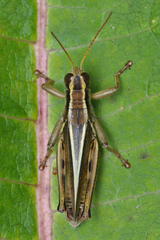 Two-striped GrasshopperMelanoplus bivittatusDamages trees, gardens or crops
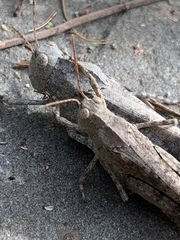 Carolina GrasshopperDissosteira carolinaDamages trees, gardens or crops
 Common Field GrasshopperChorthippus brunneus
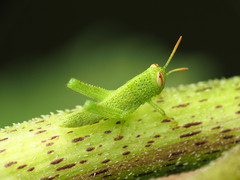 Egyptian Bird GrasshopperAnacridium aegyptium
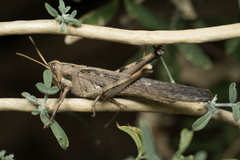 Gray Bird GrasshopperSchistocerca nitensDamages trees, gardens or crops
Sources
- Wikipedia: https://en.wikipedia.org/wiki/Large_marsh_grasshopper
Look it up elsewhere: GBIF · iNaturalist · BugGuide · Wikipedia
Text written 2026-10-22 from the sources above and checked sentence by sentence against them. Data fetched 2026-10-22.