 Bug FAQ
Large Banded Grasshopper
Arcyptera fusca · Order: Orthoptera · Family: Acrididae
Source: Wikipedia
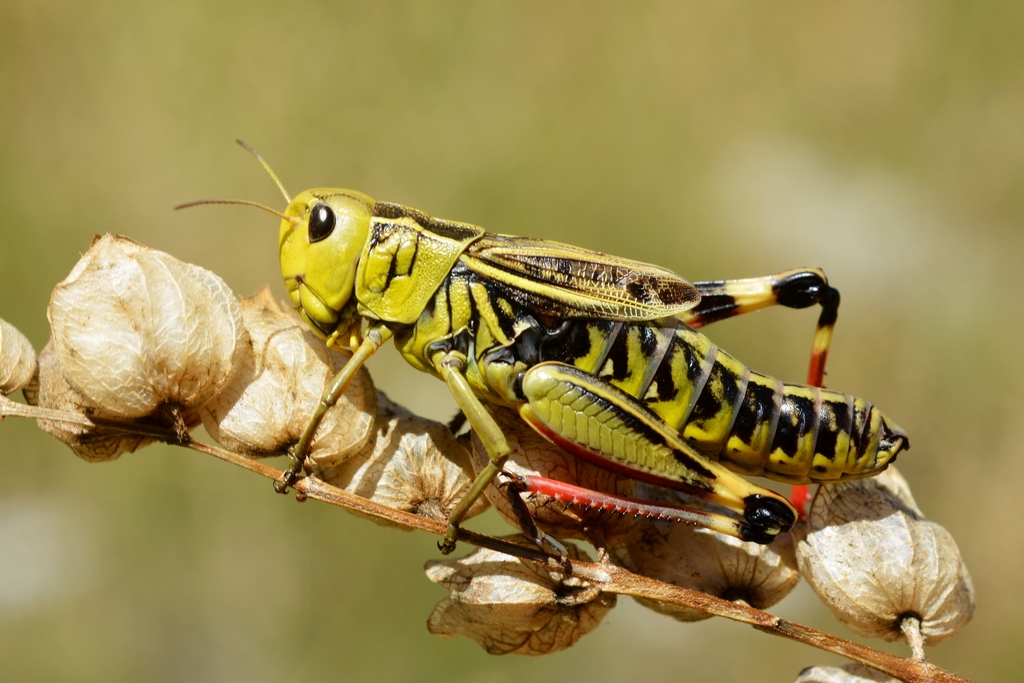
Males are 22 to 35 mm long and females 29 to 44 mm. Its body is ocher or yellow-green with dark marks, bright red hind tibiae, black knees edged with a white band.
Source: Wikipedia
Size
Males reach 22 to 35 mm (0.87 to 1.38 in) and females 29 to 44 mm (1.1 to 1.7 in) in body length.
Source: Wikipedia
What it eats
Adults mainly eat grasses (Poaceae).
Source: Wikipedia
Life cycle
Eggs are laid in oothecae within short tunnels dug in the ground.
Source: Wikipedia
Where it comes from
Native to Central Asian steppes, now widespread in most of Europe, the eastern Palearctic, and the Near East, including the Pyrenees, Alps, Carpathians, Caucasus and Siberia.
Source: Wikipedia
Lookalikes
It belongs to the short-horned grasshoppers, family Acrididae, subfamily Gomphocerinae.
Source: Wikipedia
More photos


Questions people ask
How can I recognize it?
Look for an ocher or yellow-green body with dark marks, bright red hind tibiae, black knees edged with a white band.
Source: Wikipedia
Same family (Acrididae)
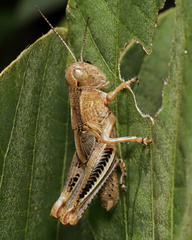 Differential GrasshopperMelanoplus differentialisDamages trees, gardens or crops
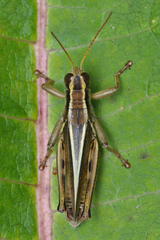 Two-striped GrasshopperMelanoplus bivittatusDamages trees, gardens or crops
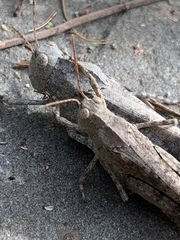 Carolina GrasshopperDissosteira carolinaDamages trees, gardens or crops
 Common Field GrasshopperChorthippus brunneus
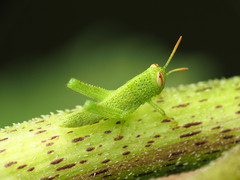 Egyptian Bird GrasshopperAnacridium aegyptium
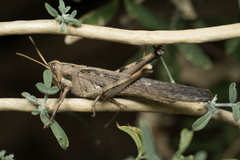 Gray Bird GrasshopperSchistocerca nitensDamages trees, gardens or crops
Sources
- Wikipedia: https://en.wikipedia.org/wiki/Arcyptera_fusca
Look it up elsewhere: GBIF · iNaturalist · BugGuide · Wikipedia
Text written 2026-10-23 from the sources above and checked sentence by sentence against them. Data fetched 2026-10-22.