 Bug FAQ
Johnson's Jumping Spider
Phidippus johnsoni · Order: Araneae · Family: Salticidae
Also called: Red-backed Jumping Spider, Johnson jumper

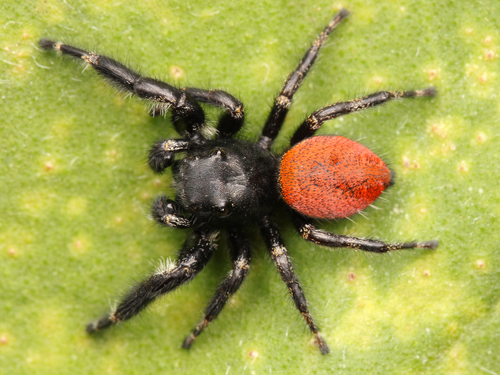
Adults are about a centimeter long and have a bright red abdomen; females also show a black central stripe, while both sexes have teal chelicerae and a mostly black body. They live from sea level up to the tree line in dry places like coastal dunes and oak woodlands, building noticeable tubular silk nests under rocks, wood, or sometimes grape vines.
Source: Wikipedia
How to recognize it
Both sexes have a bright red abdomen; females also have a black stripe down the middle, and both have teal-colored chelicerae with the rest of the body mostly black.
Source: Wikipedia
Size
Adults are roughly one centimeter long.
Source: Wikipedia
Where it lives
They occupy relatively dry habitats from sea level to the tree line, such as coastal dunes and oak woodlands. They construct conspicuous tubular silk nests under rocks, wood on the ground, and occasionally on grape vines.
Source: Wikipedia
What it eats
They usually eat prey about half their size, ranging from 2 mm to about 1 cm. Their diet includes many insects such as flies, bugs, and moths, and they also prey heavily on other spiders.
Source: Wikipedia
Life cycle
Females may sometimes eat males, showing occasional cannibalism.
Source: Wikipedia
Lookalikes
They mimic velvet ants (mutillid wasps) in size and coloration, which can have a painful sting.
Source: Wikipedia
Where it is found in the US
Recorded in 22 of 51 states and DC. Most records: California, Washington, Oregon, Utah, Montana, Colorado, Idaho, Nevada.
Darker = more records. Counts are museum and citizen-science records, not population size.
Source: GBIF
Status: native in North America; native in Canada; native in United States. Source: iNaturalist
Months it is reported in the US
Source: GBIF
More photos


Questions people ask
Why do they look like velvet ants?
They mimic the appearance of mutillid wasps, which are similar in size and coloration and have a painful sting.
Source: Wikipedia
Same family (Salticidae)



Sources
- Wikipedia: https://en.wikipedia.org/wiki/Phidippus_johnsoni
Look it up elsewhere: GBIF · iNaturalist · BugGuide · ITIS · Wikipedia
Text written 2026-10-22 from the sources above and checked sentence by sentence against them. Data fetched 2026-10-22.