 Bug FAQ
Italian locust
Calliptamus italicus · Order: Orthoptera · Family: Acrididae
Source: Wikipedia
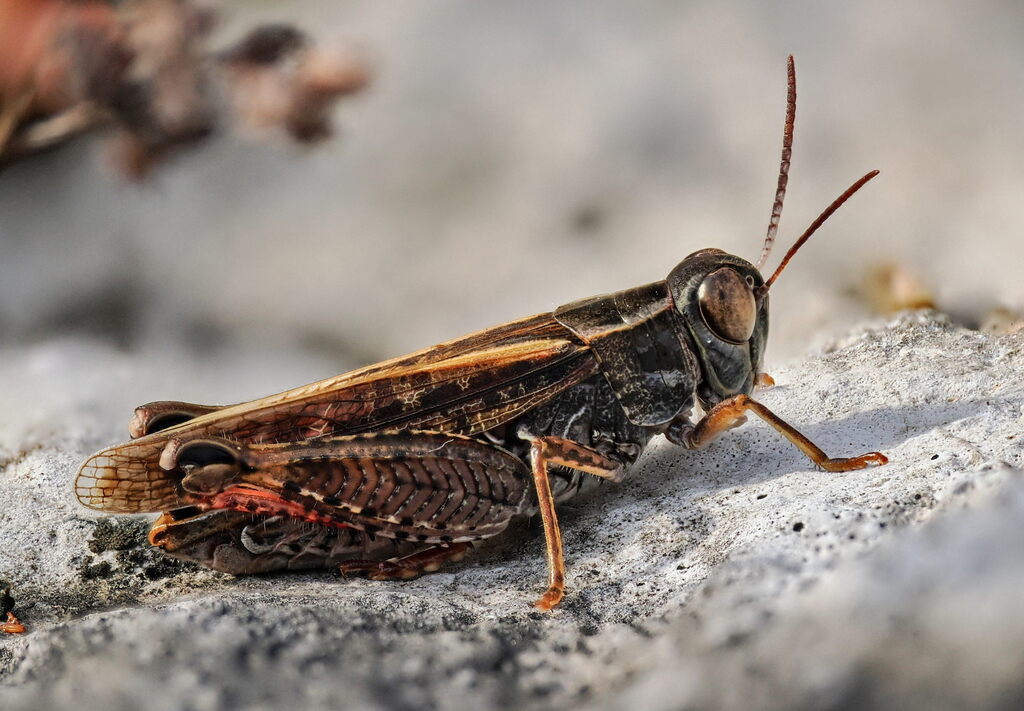
The Italian locust is a medium-sized grasshopper with gray to reddish-brown bodies and pinkish wings visible in flight. It lives in warm, dry open areas such as grasslands, rocky steppes, sand dunes and fallow land, and appears from May to October. It feeds on many wild plants and crops, especially legumes, and can become a serious pest when agricultural land is left uncultivated.
Source: Wikipedia
How to recognize it
The body colour ranges from gray to reddish-brown, and the wings show a pinkish hue when the insect flies.
Source: Wikipedia
Size
Males are 14 to 26 mm long, while females are larger at 21 to 40 mm.
Source: Wikipedia
How to get rid of it
After the USSR collapsed in 1991, large areas of uncultivated land allowed the locust to multiply, leading to a severe plague in Kazakhstan from 1998 to 2001.
Source: Wikipedia
Where it lives
It prefers warm, dry places with sparse vegetation such as grasslands, rocky steppes, old quarries, gravel pits, river rocks, sand dunes and fallow fields. It is usually found in low numbers on undisturbed sparse grassland and disappears when the area is cultivated.
Source: Wikipedia
What it eats
It eats a wide range of wild plants and also attacks crops, especially legumes. Its food includes plants from the Asteraceae, Chenopodiaceae and Poaceae families.
Source: Wikipedia
Life cycle
The species completes its life cycle in one year. Eggs are laid in late August to early September, usually on sunny rocky surfaces.
Source: Wikipedia
When you see it
Adults can be seen from July through October. Nymphs appear in May to June, and the first adults emerge in July.
Source: Wikipedia
Where it comes from
The species originates from the Central Asian steppes but is now found across most of Europe, the eastern Palearctic, North Africa and the Near East.
Source: Wikipedia
More photos


Questions people ask
What crops does it damage?
It feeds on many plants but is especially harmful to legume crops.
Source: Wikipedia
When can I expect to see them?
Adults are present from July to October, with nymphs appearing in May and June.
Source: Wikipedia
Where do they live?
They prefer warm, dry open habitats like grasslands, rocky steppes, sand dunes and fallow land.
Source: Wikipedia
Same family (Acrididae)
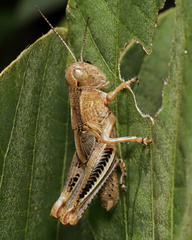 Differential GrasshopperMelanoplus differentialisDamages trees, gardens or crops
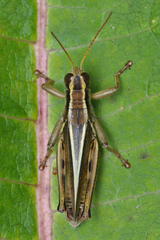 Two-striped GrasshopperMelanoplus bivittatusDamages trees, gardens or crops
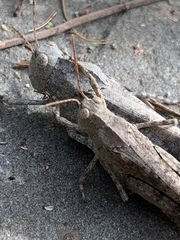 Carolina GrasshopperDissosteira carolinaDamages trees, gardens or crops
 Common Field GrasshopperChorthippus brunneus
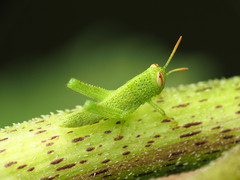 Egyptian Bird GrasshopperAnacridium aegyptium
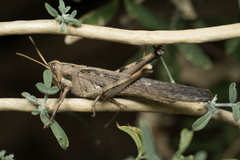 Gray Bird GrasshopperSchistocerca nitensDamages trees, gardens or crops
Sources
- Wikipedia: https://en.wikipedia.org/wiki/Calliptamus_italicus
Look it up elsewhere: GBIF · iNaturalist · BugGuide · Wikipedia
Text written 2026-10-22 from the sources above and checked sentence by sentence against them. Data fetched 2026-10-22.