 Bug FAQ
Iridescent Tortoise Beetle
Eurypepla calochroma · Order: Coleoptera · Family: Chrysomelidae
Also called: Geiger tortoise beetle
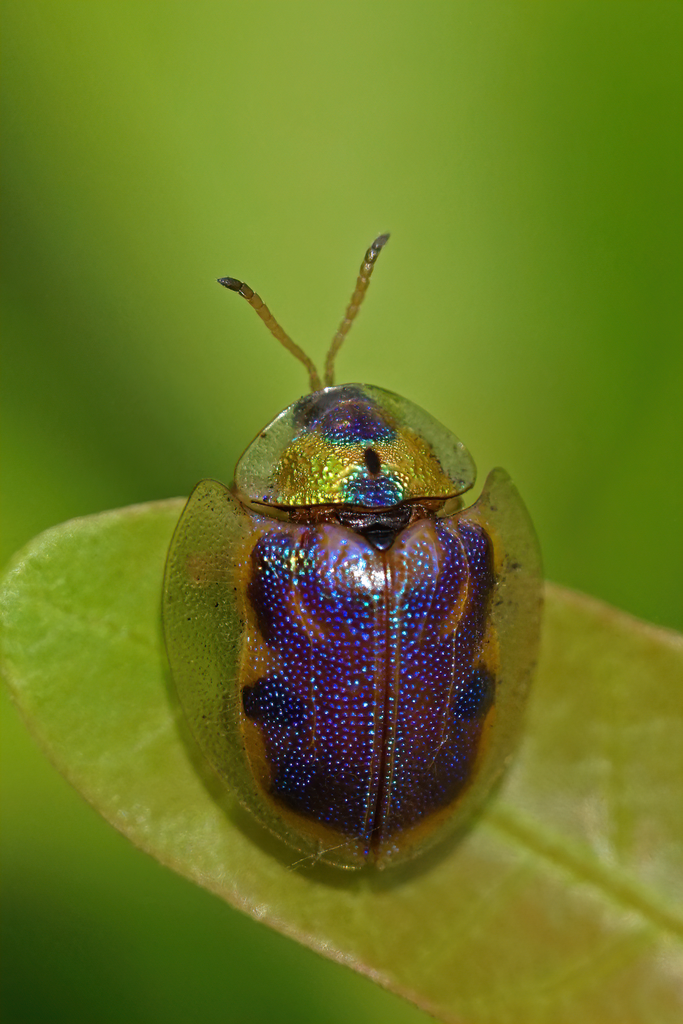
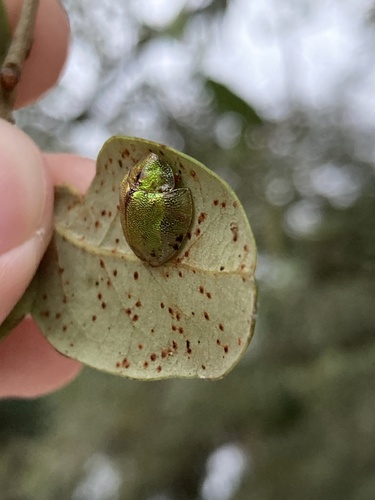
The iridescent tortoise beetle is about one centimetre long and shows a bright green colour that can shift to blues, purples, yellows or browns depending on the light. Both larvae and adults feed only on Geiger tree leaves, fruit and flowers; larvae are small, brown, slimy and carry a fecal shield, while pupae are shell-like and the emerging adult is round and yellowish.
Source: Wikipedia
How to recognize it
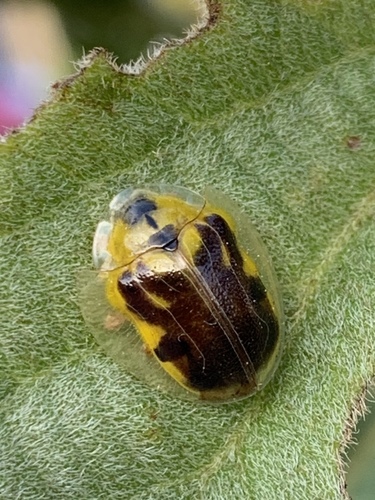
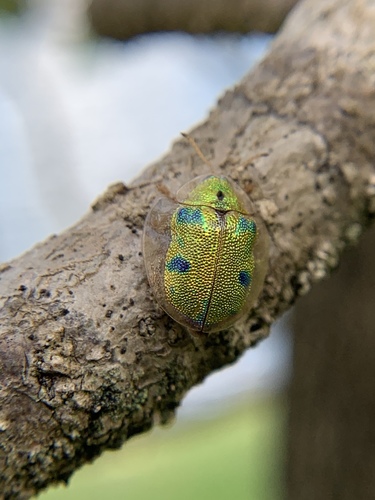
Mature adults are bright iridescent green but can change to blues, purples, yellows or browns depending on light levels.
Source: Wikipedia
Size
The beetle is about one centimetre long.
Source: Wikipedia
Where it lives
It lives in areas where Geiger trees occur, such as open woodlands, grasslands, wetlands and gardens.
Source: Wikipedia
What it eats
The species feeds exclusively on the Geiger tree throughout all life stages.
Source: Wikipedia
Life cycle
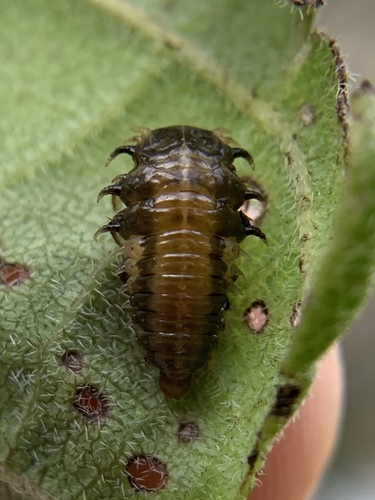
Larvae are small, brown, slimy, worm-like and carry a mass of feces on their abdomen. Pupae have a shell-like appearance, and the emerging adult is round and overall yellowish.
Source: Wikipedia
Where it is found in the US
Recorded in 2 of 51 states and DC. Most records: Florida, Georgia.
Darker = more records. Counts are museum and citizen-science records, not population size.
Source: GBIF
Months it is reported in the US
Source: GBIF
More photos
Questions people ask
What do iridescent tortoise beetles eat?
They feed only on the Geiger tree, eating its leaves, fruit and flowers.
Source: Wikipedia
Where can I find these beetles?
Look for them in open woodlands, grasslands, wetlands or gardens where Geiger trees grow, especially in Florida, Central America and the Caribbean.
Source: Wikipedia
What do the larvae look like?
The larvae are small, brown, slimy, worm-like and have a fecal shield on their abdomen.
Source: Wikipedia
Same family (Chrysomelidae)
 Spotted Cucumber BeetleDiabrotica undecimpunctataDamages trees, gardens or crops
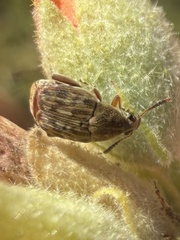 Bean WeevilAcanthoscelides obtectusDamages trees, gardens or crops
 Cowpea WeevilCallosobruchus maculatusDamages trees, gardens or crops
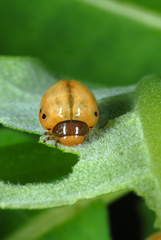 Swamp Milkweed Leaf BeetleLabidomera clivicollisDamages trees, gardens or crops
 Alder Leaf BeetleAgelastica alniDamages trees, gardens or crops
 Dogbane Leaf BeetleChrysochus auratus
Sources
- Wikipedia: https://en.wikipedia.org/wiki/Eurypepla_calochroma
Look it up elsewhere: GBIF · iNaturalist · BugGuide · ITIS · Wikipedia
Text written 2026-10-26 from the sources above and checked sentence by sentence against them. Data fetched 2026-10-26.