 Bug FAQ
Intertidal Jumping Spider
Terralonus californicus · Order: Araneae · Family: Salticidae
Also called: Beach-dwelling Jumping Spider, West Coast Jumping Spider

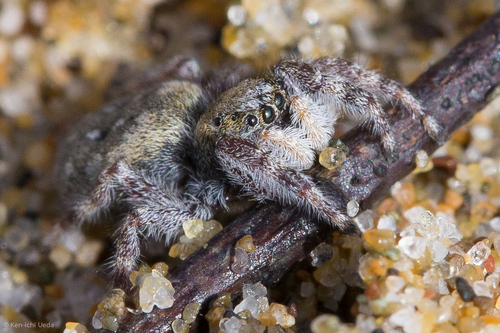
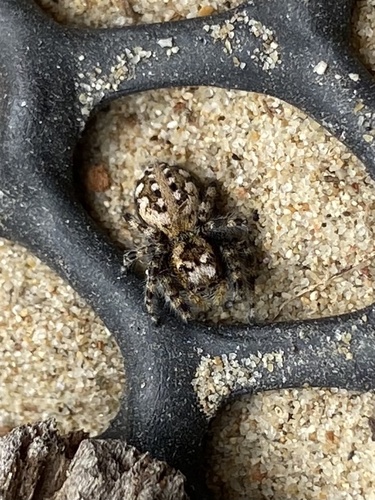
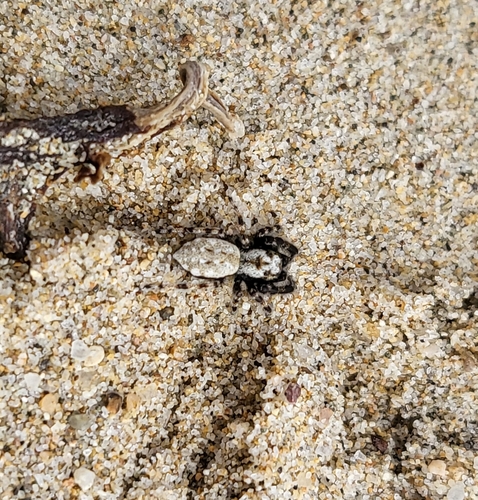
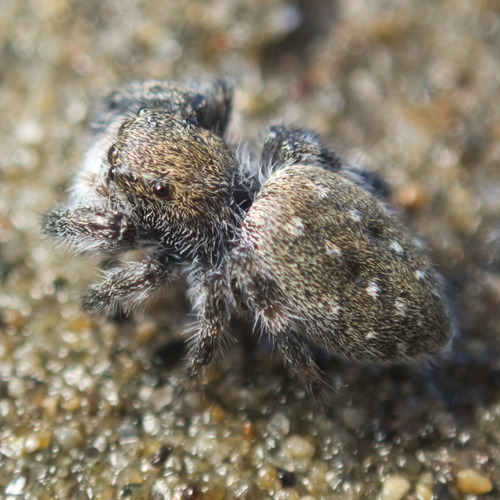
The intertidal jumping spider measures about 3 to 5 mm long and shows mixed black, gray, and tan colors that blend with beach sand. Males have longer front legs they use for fighting other males and for courtship displays. It lives on sandy Pacific coast beaches from southern British Columbia down to Baja California, hunting small arthropods such as beach hoppers and flies.
Source: Wikipedia
How to recognize it
Both sexes are patterned in black, gray, and tan, providing camouflage on the shoreline. Males have noticeably elongated forelimbs used in male-to-male aggression and courtship.
Source: Wikipedia
Size
Adults range from 3 to 5 mm in body length.
Source: Wikipedia
Where it lives
It is one of the few spiders that regularly occupy beach and intertidal zones.
Source: Wikipedia
What it eats
It preys on small beach-dwelling arthropods such as amphipod hoppers and flies attracted to shoreline debris.
Source: Wikipedia
Where it comes from
The species is native to the Pacific coast of North America, from southern British Columbia to Baja California.
Source: Wikipedia
Lookalikes
It resembles other Terralonus spiders, so finding it on a beach is the key clue to its identity.
Source: Wikipedia
Where it is found in the US
Recorded in 4 of 51 states and DC. Most records: California, Oregon, Washington, Indiana.
Darker = more records. Counts are museum and citizen-science records, not population size.
Source: GBIF
Status: native in North America; native in Canada. Source: iNaturalist
Months it is reported in the US
Source: GBIF
More photos
Questions people ask
How can I tell this spider apart from other similar spiders?
Look for the mixed black, gray, and tan coloration and, in males, the longer front legs; its presence on a beach setting also points to this species.
Source: Wikipedia
Where might I find an intertidal jumping spider?
They are found on sandy Pacific coast beaches and in the intertidal zone from southern British Columbia to Baja California.
Source: Wikipedia
What does this spider eat?
It hunts small arthropods that live on the shore, such as beach hopper amphipods and flies.
Source: Wikipedia
Same family (Salticidae)



Sources
- Wikipedia: https://en.wikipedia.org/wiki/Terralonus_californicus
Look it up elsewhere: GBIF · iNaturalist · BugGuide · ITIS · Wikipedia
Text written 2026-10-25 from the sources above and checked sentence by sentence against them. Data fetched 2026-10-25.