 Bug FAQ
Interrupted Spider Wasp
Poecilopompilus interruptus · Order: Hymenoptera · Family: Pompilidae

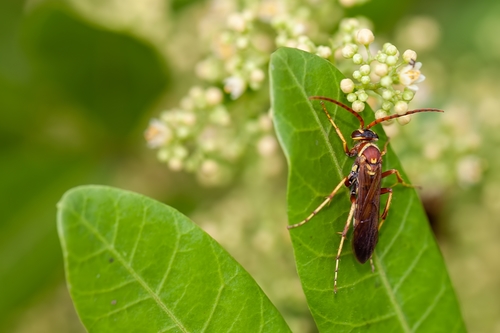
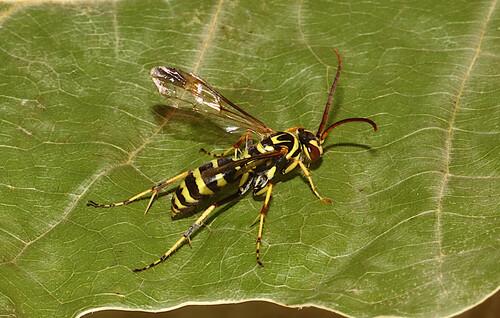
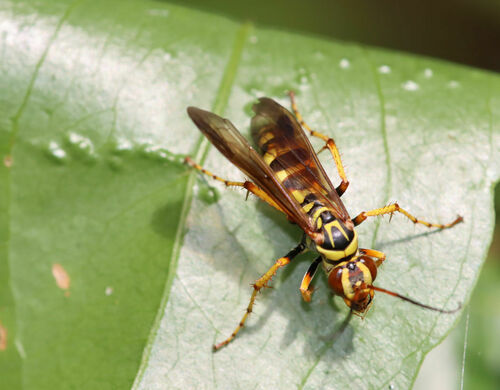
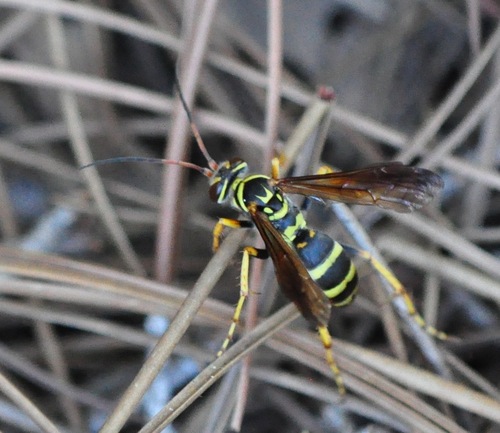
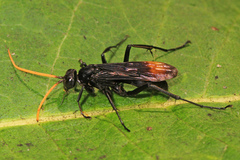
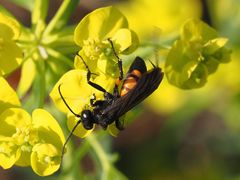
The Interrupted Spider Wasp is about 13 mm long and has long orange antennae, brown-yellow legs, and brown wings with distinct rufous-brown and yellow bands on its body. Females hunt orb-weaver spiders (Araneidae) and may occasionally drink the spider’s blood, while adults visit a variety of flowers such as cotton, sunflowers, and alfalfa. It is a New World species that mimics paper wasps of the genus Polistes and can be found on extrafloral nectaries of plants like cotton and sunflower in California.
Source: Wikipedia
Size
Adults measure about 13 mm in length.
Source: Wikipedia
Where it lives
In California, females have been collected on extrafloral nectaries of cotton and both sexes on those of sunflower. Adults also visit flowers such as Chrysothamnus, alfalfa, and various ericaceous plants.
Source: Wikipedia
What it eats
Females sometimes feed on the haemolymph of captured spiders. Their primary prey are orb-weaver spiders of the family Araneidae.
Source: Wikipedia
Life cycle
The species appears to be a Müllerian mimic of paper wasps in the genus Polistes.
Source: Wikipedia
Where it comes from
It is a New World spider wasp species.
Source: Wikipedia
Lookalikes
To tell it apart from P. algidus, examine the front tarsi of females: P. interruptus has four weak spines and parallel inner eye margins, whereas P. algidus has three strong spines and convergent eye margins.
Source: Wikipedia
Where it is found in the US
Recorded in 34 of 51 states and DC. Most records: Florida, Texas, Illinois, Louisiana, Kansas, Maryland, Georgia, Oklahoma.
Darker = more records. Counts are museum and citizen-science records, not population size.
Source: GBIF
Months it is reported in the US
Source: GBIF
More photos
Questions people ask
How can I recognize the Interrupted Spider Wasp?
Look for a 13 mm wasp with long orange antennae, brown-yellow legs, brown wings, and bold rufous-brown and yellow bands on its body.
Source: Wikipedia
What does this wasp eat?
Females hunt orb-weaver spiders and may drink the spider’s blood; adults also visit many flowers for nectar.
Source: Wikipedia
Where might I find this wasp?
In California it is seen on cotton and sunflower nectaries and on a variety of other flowering plants.
Source: Wikipedia
How is it different from similar spider wasps?
Check the front tarsi of females: this species has four weak spines and parallel inner eye margins, unlike the three strong spines and convergent eye margins of P. algidus.
Source: Wikipedia
Same family (Pompilidae)
Sources
- Wikipedia: https://en.wikipedia.org/wiki/Poecilopompilus_interruptus
Look it up elsewhere: GBIF · iNaturalist · BugGuide · Wikipedia
Text written 2026-10-24 from the sources above and checked sentence by sentence against them. Data fetched 2026-10-24.