 Bug FAQ
Indian Palm Bob
Suastus gremius · Order: Lepidoptera · Family: Hesperiidae
Also called: Oriental Palm Bob, Palm Bob
Source: Wikipedia
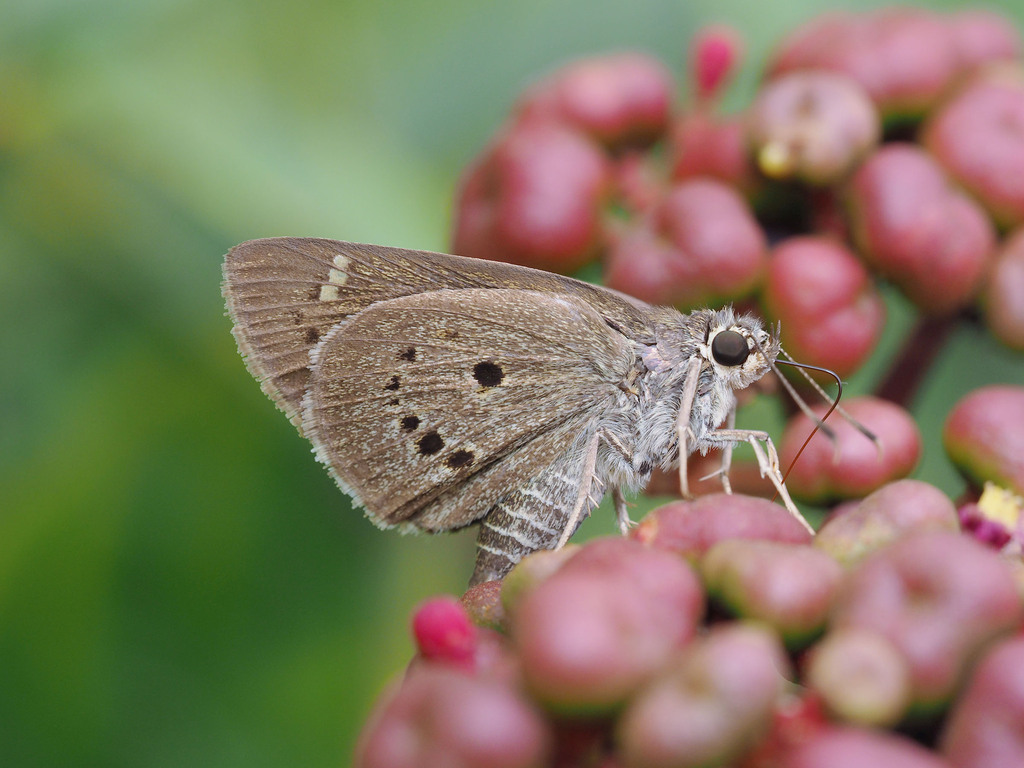
Adult Indian Palm Bobs have olive-brown uppersides with distinctive white and ochre spots on the forewings. They live in the Indomalayan region and their larvae eat the leaves of palms such as Phoenix, Rhapis, Caryota and Washingtonia.
Source: Wikipedia
How to recognize it
The upper side of the butterfly is olive-brown. Forewings show a pattern of ochre-white spots, including a small central spot, three sub-apical spots, and three larger discal spots arranged obliquely.
Source: Wikipedia
Where it lives
It is found throughout the Indomalayan realm.
Source: Wikipedia
What it eats
Caterpillars feed on palm species such as Phoenix, Rhapis, Caryota and Washingtonia.
Source: Wikipedia
Life cycle
The larval stage consumes the same palm hosts as listed for its diet.
Source: Wikipedia
Where it comes from
Its natural range is the Indomalayan region.
Source: Wikipedia
Lookalikes
Females are usually paler, larger, and have broader forewing spots than males; the two upper discal spots are square and the middle spot is indented on the outer side.
Source: Wikipedia
Questions people ask
Do the caterpillars damage palm trees?
Yes, the larvae feed on the leaves of several palm species and can harm ornamental or cultivated palms.
Source: Wikipedia
Same family (Hesperiidae)




Sources
- Wikipedia: https://en.wikipedia.org/wiki/Suastus_gremius
Look it up elsewhere: GBIF · iNaturalist · BugGuide · Wikipedia
Text written 2026-10-22 from the sources above and checked sentence by sentence against them. Data fetched 2026-10-22.