 Bug FAQ
Hypericum pot beetle
Cryptocephalus moraei · Order: Coleoptera · Family: Chrysomelidae
Source: Wikipedia
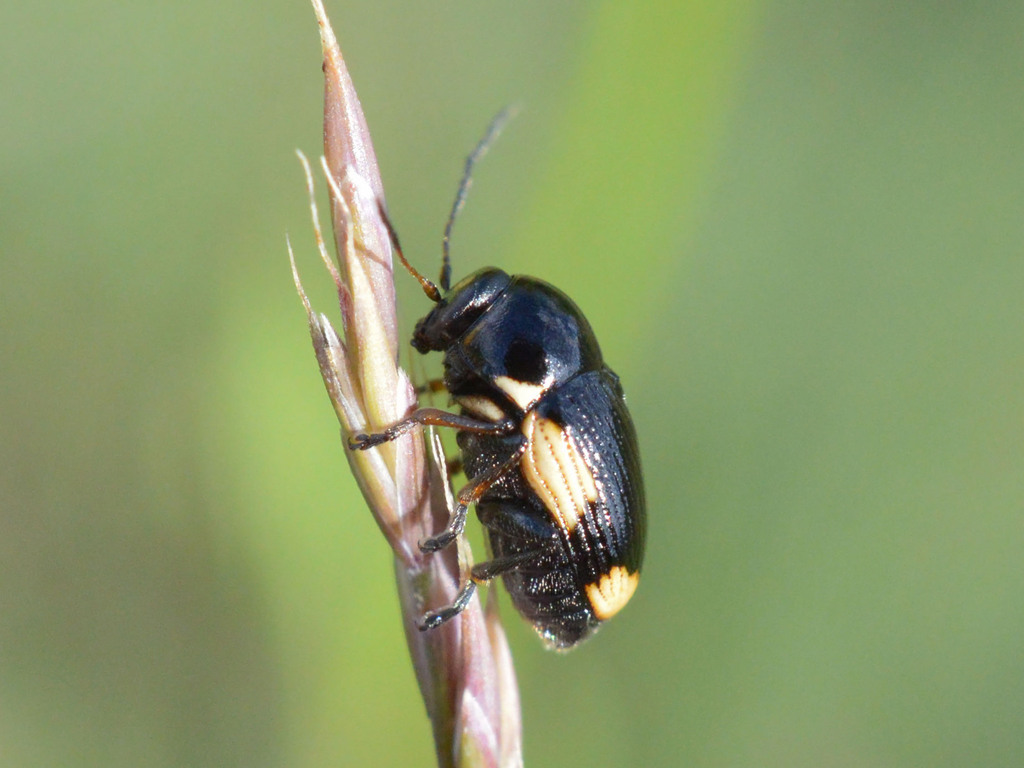
The beetle is 3 to 5 mm long and has reddish-brown legs. Males have yellow heads, females a black head with two yellow spots. It is seen from May to August and lives on Hypericum species across Europe.
Source: Wikipedia
How to recognize it
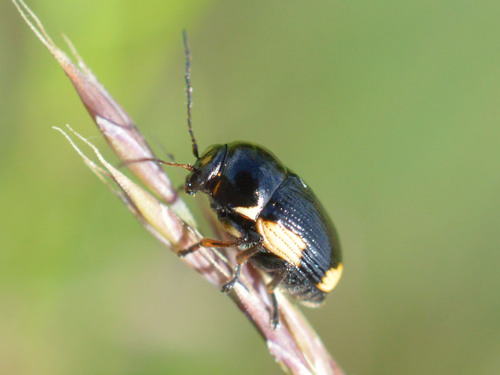
Antennae start black-brown then become fully black. Prothorax is black with a yellow smudge near the rear corners. Elytra have rows of robust points, mostly black with a yellow stain at the end.
Source: Wikipedia
Size
Adults measure 3 to 5 mm.
Source: Wikipedia
Where it lives
Active May through August on Hypericum plants.
Source: Wikipedia
What it eats
Feeds on species of the Hypericum genus.
Source: Wikipedia
When you see it
Seen from May to August.
Source: Wikipedia
Where it comes from
Recorded throughout Europe in scientific and citizen-science data.
Source: Wikipedia
Lookalikes
It belongs to the Cryptocephalus genus of leaf beetles.
Source: Wikipedia
Status: introduced in Canada. Source: iNaturalist
More photos
Questions people ask
Same family (Chrysomelidae)
 Spotted Cucumber BeetleDiabrotica undecimpunctataDamages trees, gardens or crops
 Bean WeevilAcanthoscelides obtectusDamages trees, gardens or crops
 Cowpea WeevilCallosobruchus maculatusDamages trees, gardens or crops
 Swamp Milkweed Leaf BeetleLabidomera clivicollisDamages trees, gardens or crops
 Alder Leaf BeetleAgelastica alniDamages trees, gardens or crops
 Dogbane Leaf BeetleChrysochus auratus
Sources
- Wikipedia: https://en.wikipedia.org/wiki/Cryptocephalus_moraei
Look it up elsewhere: GBIF · iNaturalist · BugGuide · Wikipedia
Text written 2026-10-23 from the sources above and checked sentence by sentence against them. Data fetched 2026-10-22.