 Bug FAQ
Hyllus argyrotoxus
Hyllus argyrotoxus · Order: Araneae · Family: Salticidae

Hyllus argyrotoxus is a medium to large jumping spider with a sturdy body and relatively long legs. It lives on low vegetation and shrubs in many South African habitats, from fynbos to savanna, from sea level up to about 1500 m.
Source: Wikipedia
How to recognize it
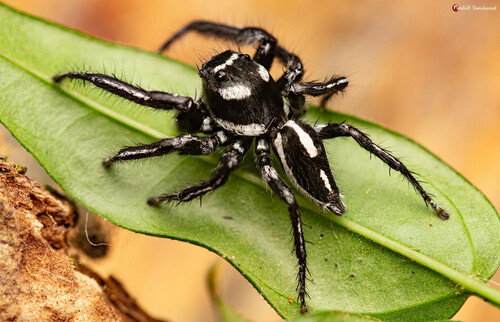
The spider’s colour pattern is a contrast of black, dark brown and white or silvery spots, especially vivid in males.
Source: Wikipedia
What it eats
It stalks and captures small arthropods by short, rapid leaps. Like other Hyllus species, it is a visually oriented predator that hunts on vegetation.
Source: Wikipedia
When you see it
It is diurnal and actively hunts using vision rather than webs.
Source: Wikipedia
Lookalikes
Members of the genus Hyllus are robust, visually oriented predators adapted to hunting on vegetation.
Source: Wikipedia
More photos
Questions people ask
What does it eat?
It hunts small arthropods, leaping short distances to capture them, and relies on its keen eyesight while hunting on plants.
Source: Wikipedia
How does it reproduce?
Females create silken retreats on the underside of leaves, fold the leaf into a tube, and guard the egg sac inside.
Source: Wikipedia
Same family (Salticidae)


Sources
- Wikipedia: https://en.wikipedia.org/wiki/Hyllus_argyrotoxus
Look it up elsewhere: GBIF · iNaturalist · BugGuide · ITIS · Wikipedia
Text written 2026-10-23 from the sources above and checked sentence by sentence against them. Data fetched 2026-10-23.