 Bug FAQ
Convolvulus Hawkmoth
Agrius convolvuli · Order: Lepidoptera · Family: Sphingidae
Also called: Convolvulus Hawk Moth, Horntailed Caterpillar, Sweet Potato Hornworm, Sweet Potato Moth
Source: Wikipedia

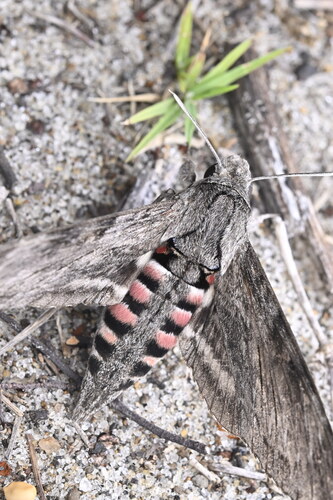
The Convolvulus hawkmoth has a wingspan of about 80 to 105 mm and shows grayish wings with a broad gray stripe on the abdomen and pink-black side bands. Its caterpillars feed on Convolvulus leaves and can also become pests of sweet potato crops in some regions. Adults are attracted to light, are active at dusk, and have a very long proboscis for feeding on deep flowers.
Source: Wikipedia
How to recognize it
The moth’s basic colour is gray, with a wide gray stripe on the back of the abdomen and pink-black bands edged in white on the sides. Its hindwings are light gray with broad dark crosslines.
Source: Wikipedia
Size
The wingspan ranges from 80 to 105 mm (about 3.1 to 4.1 in).
Source: Wikipedia
Is it a pest in the house?
In New Zealand and the Pacific it can become a pest of cultivated sweet potato (Ipomoea batatas).
Source: Wikipedia
Where it lives
It is common across Europe, Asia, Africa, Australia and New Zealand, often arriving as a migrant. The moth is strongly attracted to lights and is frequently killed on highways.
Source: Wikipedia
What it eats
Caterpillars eat the leaves of Convolvulus plants, which gives the species its name. Adults feed while hovering, using a proboscis longer than their body to reach deep flowers such as Nicotiana, petunias and lilies.
Source: Wikipedia
Life cycle
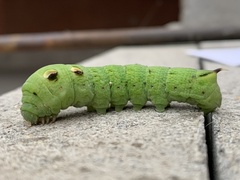
Caterpillars can appear in brown, bright green or black colours.
Source: Wikipedia
When you see it
They are most active at sunset and during twilight, often seen hovering over garden flowers.
Source: Wikipedia
Lookalikes
In the western part of its range it may be confused with the related Agrius cingulata.
Source: Wikipedia
Where it is found in the US
Recorded in 1 of 51 states and DC. Most records: Michigan.
Darker = more records. Counts are museum and citizen-science records, not population size.
Source: GBIF
More photos


Questions people ask
Is it a problem for my garden?
It can damage sweet potato plants in some regions, but otherwise it mainly feeds on Convolvulus leaves.
Source: Wikipedia
Why do they keep hitting my car lights?
The moth is strongly attracted to artificial lights, which often leads to collisions on highways.
Source: Wikipedia
How can I tell it apart from similar moths?
Look for a broad gray dorsal stripe on the abdomen and pink-black side bands edged with white; it may be confused with Agrius cingulata in western areas.
Source: Wikipedia
Same family (Sphingidae)
 White-lined SphinxHyles lineataDamages trees, gardens or crops
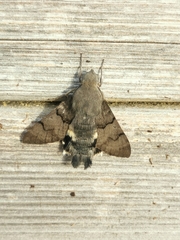 Eurasian Hummingbird HawkmothMacroglossum stellatarum
 Snowberry ClearwingHemaris diffinis
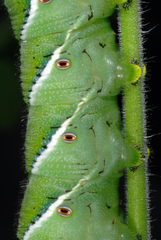 Carolina SphinxManduca sextaDamages trees, gardens or crops
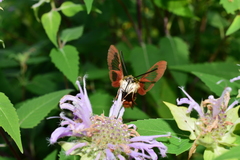 Hummingbird ClearwingHemaris thysbeDamages trees, gardens or crops
 Elephant HawkmothDeilephila elpenor
Sources
- Wikipedia: https://en.wikipedia.org/wiki/Agrius_convolvuli
Look it up elsewhere: GBIF · iNaturalist · BugGuide · Wikipedia
Text written 2026-10-22 from the sources above and checked sentence by sentence against them. Data fetched 2026-10-22.