 Bug FAQ
Howard's Gallinipper
Psorophora howardii · Order: Diptera · Family: Culicidae
Source: Wikipedia
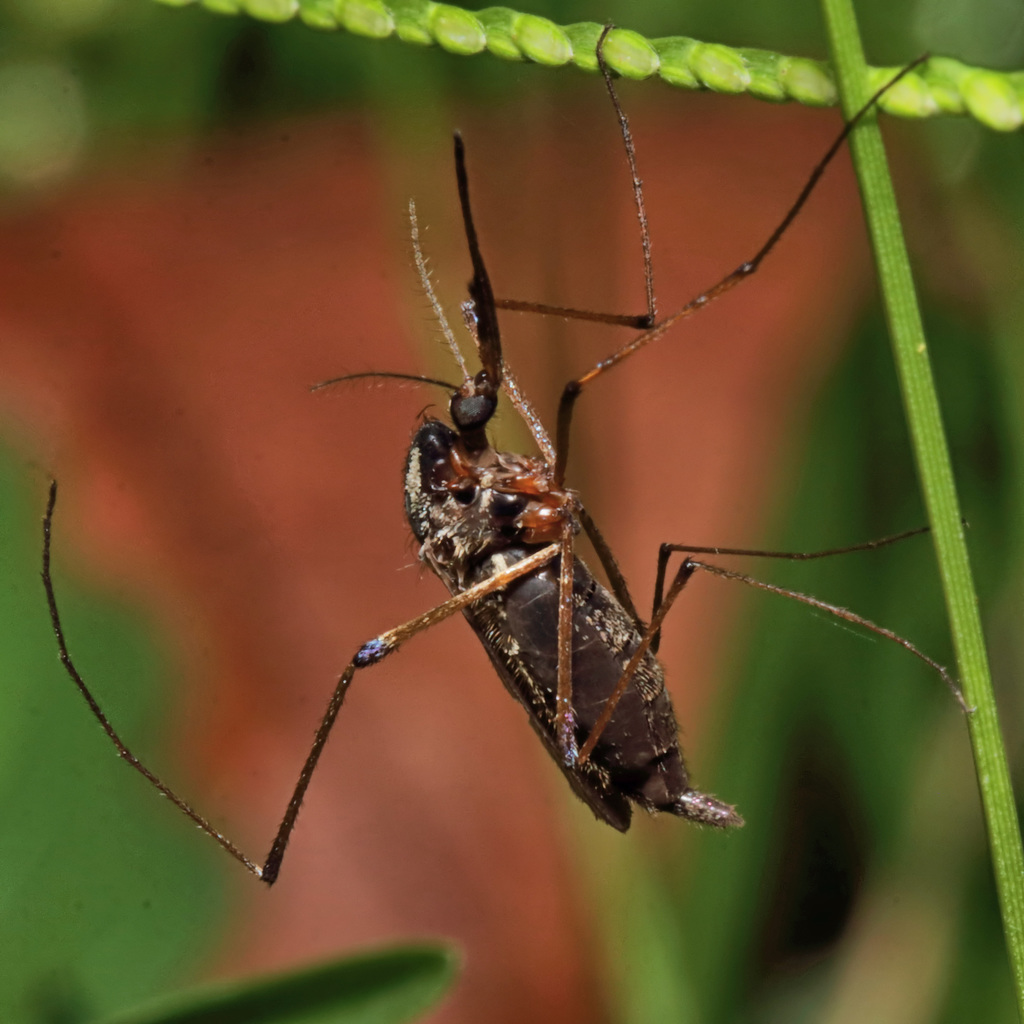
Howard's Gallinipper is a large mosquito about 8 to 10 mm long with a wing length of roughly 6 mm. Females bite persistently at any time of day and can transmit West Nile virus.
Source: Wikipedia
How to recognize it
The wings have narrow dark-brown scales; the head is covered with broad gray-white scales except for a narrow bare stripe; the thorax is dark brown to black; the abdomen shows a wide white-scaled median patch; legs are dark yellow and purple.
Source: Wikipedia
Size
Adults measure 8 to 10 mm in length with wings about 6.0 to 6.5 mm long.
Source: Wikipedia
Does it bite or sting?
Adult females bite persistently at any time of day and can transmit West Nile virus.
Source: Wikipedia
Life cycle
Larvae are present from March through October, and eggs hatch when rain or irrigation fills their habitats.
Source: Wikipedia
When you see it
Larval activity occurs from March to October.
Source: Wikipedia
Where it is found in the US
Recorded in 27 of 51 states and DC. Most records: Florida, Virginia, Maryland, Alabama, Texas, Indiana, Illinois, Louisiana.
Darker = more records. Counts are museum and citizen-science records, not population size.
Source: GBIF
Months it is reported in the US
Source: GBIF
More photos

Questions people ask
Same family (Culicidae)
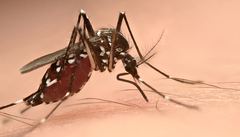 Asian Tiger MosquitoAedes albopictusCan spread germs or disease
 House Mosquito ComplexCulex pipiensCan spread germs or disease
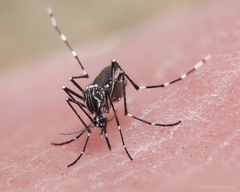 Yellow Fever MosquitoAedes aegyptiCan spread germs or disease
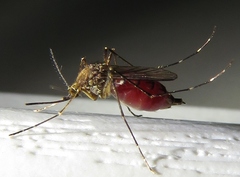 Inland Floodwater MosquitoAedes vexansCan spread germs or disease
 Asian Bush MosquitoAedes japonicusCan bite
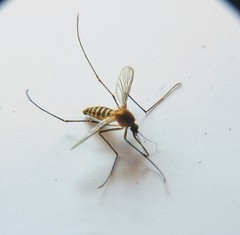 Southern House MosquitoCulex quinquefasciatusCan spread germs or disease
Sources
- Wikipedia: https://en.wikipedia.org/wiki/Psorophora_howardii
Look it up elsewhere: GBIF · iNaturalist · BugGuide · ITIS · Wikipedia
Text written 2026-10-23 from the sources above and checked sentence by sentence against them. Data fetched 2026-10-23.