 Bug FAQ
Asian Bush Mosquito
Aedes japonicus · Order: Diptera · Family: Culicidae
Also called: Asian Rock Pool Mosquito, Japanese bush mosquito

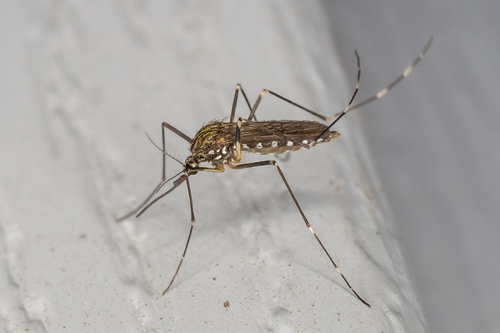
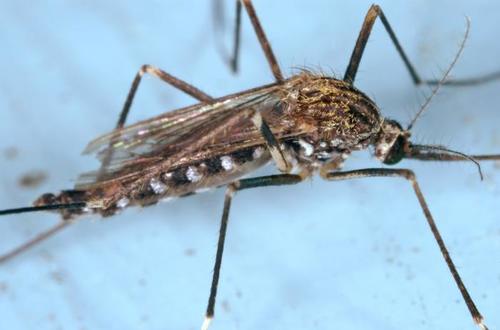
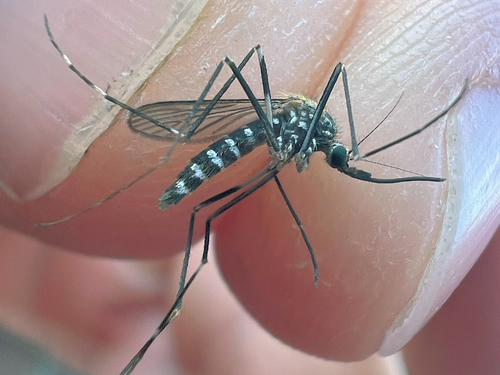
Adults have a bronze-colored lyre pattern on the thorax and females show golden stripes; larvae have distinctive setae and a spiculated anal saddle. They breed in rock pools, tree holes, buckets and tire interiors, preferring shaded, organic-rich water. They are native to eastern Asia and have spread to the United States, first recorded in Florida in 2012.
How to recognize it
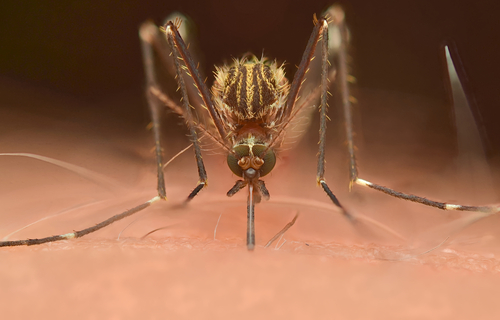
Adults show a bronze lyre-shaped mark on the scutum and females have golden dorsal stripes.
Is it a pest in the house?
They adapt well to human environments and tolerate cooler, temperate climates better than many invasive container mosquitoes. First US record was in Okaloosa County, Florida in 2012, now found in several panhandle counties.
Source: UF/IFAS
Does it bite or sting?
Adults are day-biters in forested areas but are reluctant to bite humans. They can experimentally transmit West Nile virus and are considered an active vector of that disease.
How to get rid of it
Parasitic water mites can reduce mosquito fecundity and may help control populations. Used tires in international trade are a likely pathway for introduction, similar to Aedes albopictus.
Where it lives
Larvae develop in rock pools near streams and in artificial containers like buckets, tree holes, and tire interiors. Adults prefer temperate climates and can survive cold by entering egg diapause.
Source: Wikipedia
Life cycle
Females lay about 114 eggs per gonotrophic cycle, ovipositing 2 to 3 times per cycle. Eggs resist drying and can enter diapause when temperatures are low.
Source: Wikipedia
When you see it
They are active from early spring to early autumn, with larvae appearing as soon as snowmelt water is present.
Source: Wikipedia
Where it comes from
Native to eastern Asia, including Japan, Taiwan, Hong Kong, China, Korea and parts of Russia.
Source: Wikipedia
Lookalikes
Several subspecies and sibling species in Asia are hard to separate from Aedes japonicus using only morphology. Aedes japonicus larvae appear earlier in the year than other Aedes species when temperatures are cooler.
Source: UF/IFAS
Where it is found in the US
Recorded in 36 of 51 states and DC. Most records: Illinois, Indiana, North Carolina, Iowa, Ohio, Maryland, Massachusetts, Virginia.
Darker = more records. Counts are museum and citizen-science records, not population size.
Source: GBIF
Status: introduced in North America; introduced in United States; introduced in Canada. Source: iNaturalist
Months it is reported in the US
Source: GBIF
More photos
Questions people ask
How can I identify Asian Bush Mosquito adults?
Look for a bronze lyre-shaped mark on the thorax and golden stripes on females.
Where does this mosquito breed?
In rock pools, tree holes, buckets, and the inside of tires that hold moist, shaded water.
Source: Wikipedia
Does it bite people?
Yes, during the day, though it seems reluctant to bite people.
Same family (Culicidae)
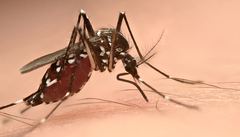 Asian Tiger MosquitoAedes albopictusCan spread germs or disease
 House Mosquito ComplexCulex pipiensCan spread germs or disease
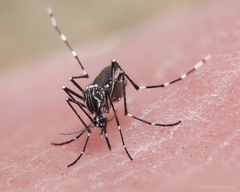 Yellow Fever MosquitoAedes aegyptiCan spread germs or disease
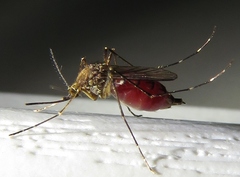 Inland Floodwater MosquitoAedes vexansCan spread germs or disease
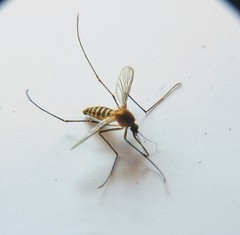 Southern House MosquitoCulex quinquefasciatusCan spread germs or disease
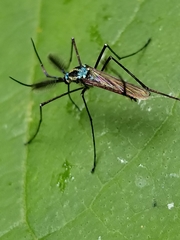 Elephant MosquitoToxorhynchites rutilusHarmless
Sources
- Wikipedia: https://en.wikipedia.org/wiki/Aedes_japonicus
- UF/IFAS: https://edis.ifas.ufl.edu/publication/IN1307
Look it up elsewhere: GBIF · iNaturalist · BugGuide · ITIS · Wikipedia
Text written 2026-10-23 from the sources above and checked sentence by sentence against them. Data fetched 2026-10-23.