 Bug FAQ
Horace's Duskywing
Erynnis horatius · Order: Lepidoptera · Family: Hesperiidae

The wingspan ranges from about 36 to 49 mm.
Source: Wikipedia
How to recognize it
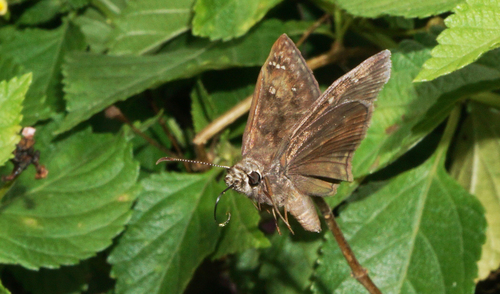
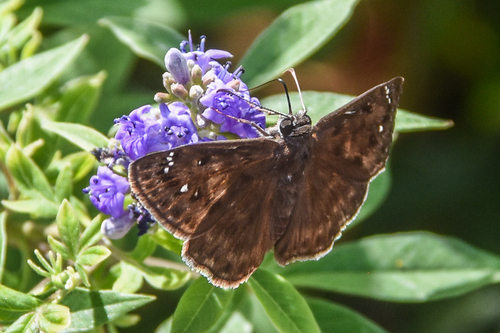
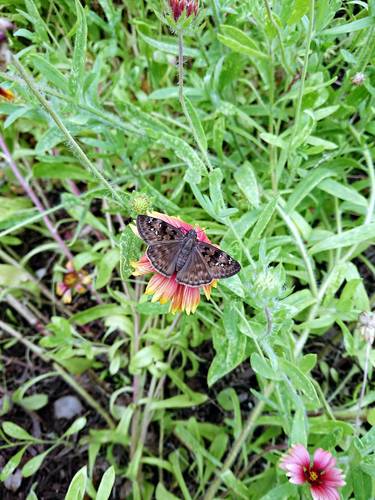
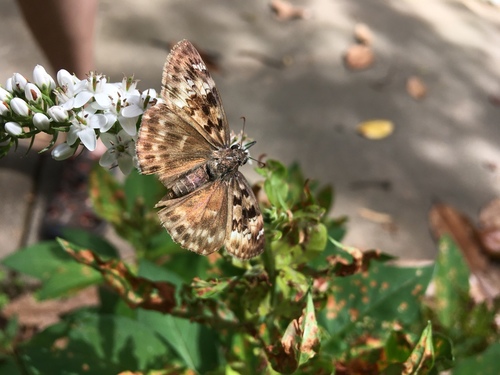
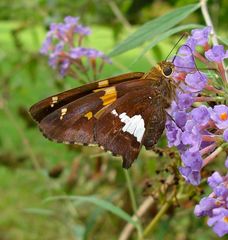
The wing fringes are brown. Male forewings are dark brown with little contrast and lack white overscaling. Female forewings are light brown, show a contrasting pattern and have large transparent spots. The underside of the hindwing usually does not have two spots below the apex. Males have a costal fold on the forewing that holds yellow scent scales; females have a patch of scent scales on the seventh abdominal segment.
Source: Wikipedia
Size
Wingspan measures between 36 and 49 mm.
Source: Wikipedia
What it eats
Caterpillars feed on various oaks such as willow oak, northern red oak, scrub oak, water oak, post oak and live oak.
Source: Wikipedia
Life cycle
In the north there are two generations, with adults flying from April through September.
Source: Wikipedia
When you see it
Two generations occur in the north, adults present April-September; three generations occur in the deep south and Texas, adults present January-November.
Source: Wikipedia
Where it is found in the US
Recorded in 44 of 51 states and DC. Most records: Florida, Texas, Georgia, North Carolina, Virginia, Maryland, South Carolina, New Jersey.
Darker = more records. Counts are museum and citizen-science records, not population size.
Source: GBIF
Status: native in North America; native in United States. Source: iNaturalist
Months it is reported in the US
Source: GBIF
More photos
Same family (Hesperiidae)




Sources
- Wikipedia: https://en.wikipedia.org/wiki/Erynnis_horatius
Look it up elsewhere: GBIF · iNaturalist · BugGuide · ITIS · Wikipedia
Text written 2026-10-22 from the sources above and checked sentence by sentence against them. Data fetched 2026-10-22.