 Bug FAQ
Holly Tortrix
Rhopobota naevana · Order: Lepidoptera · Family: Tortricidae
Also called: Black-headed Fireworm
Source: Wikipedia
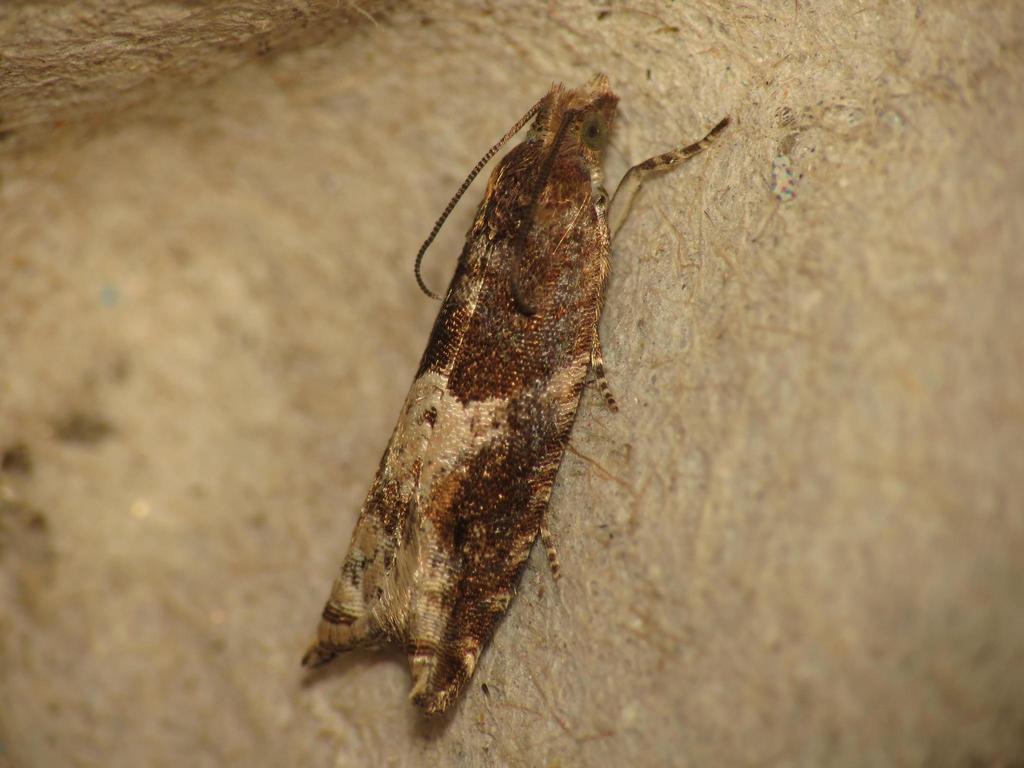
The larvae eat leaves of Vaccinium, Erica, holly, apple, hawthorn, rowan, plum, pear and buckthorn, which can harm garden and orchard plants. Adults are on the wing from late June through early September.
Source: Wikipedia
How to recognize it
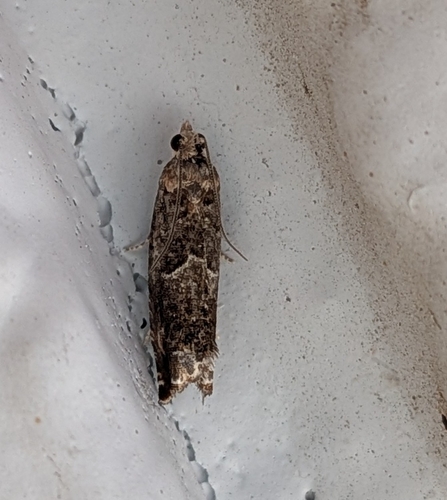
The forewings are grey with faint whitish streaks and a large basal patch that has an angled edge and is lighter toward the front. A dark central band has a rearward middle point and is a deep brownish-grey, sometimes with black spots. Small dark spots appear on the rear part of the leading edge, with a faint streak running down from the wing tip. The eye-like spot near the wing tip is outlined with a light metallic-grey border. The hindwings are grey; in males the underside near the front edge is darkened with black.
Source: Wikipedia
Size
The moth’s wingspan ranges from about 12 to 16 mm.
Source: Wikipedia
Where it lives
It lives across Europe, eastern Russia, China, Taiwan, Mongolia, Korea, Japan, India, Sri Lanka and North America.
Source: Wikipedia
What it eats
The caterpillars feed on a variety of plants such as Vaccinium, Erica carnea, holly, apple, hawthorn, rowan, plum, pear and buckthorn.
Source: Wikipedia
Life cycle
Adult moths are active from late June to early September.
Source: Wikipedia
When you see it
Adults are on wing from late June through early September.
Source: Wikipedia
Where it comes from
Its range also includes China, Taiwan, Mongolia, Korea, Japan, India and Sri Lanka.
Source: Wikipedia
Where it is found in the US
Recorded in 22 of 51 states and DC. Most records: Washington, Alaska, Mississippi, North Carolina, Kentucky, Michigan, New York, Oregon.
Darker = more records. Counts are museum and citizen-science records, not population size.
Source: GBIF
Status: native in North America; native in Canada. Source: iNaturalist
Months it is reported in the US
Source: GBIF
More photos
Questions people ask
What plants do the larvae eat?
The caterpillars feed on Vaccinium, Erica carnea, holly, apple, hawthorn, rowan, plum, pear and buckthorn.
Source: Wikipedia
When are the adult moths active?
Adults are on the wing from late June to early September.
Source: Wikipedia
How can I recognise the holly tortrix moth?
Look for a small grey moth with a large angled basal patch on the forewing, a dark central band with a rearward projection, small dark spots on the rear edge of the wing, and a metallic-grey edged eye-spot.
Source: Wikipedia
Is the holly tortrix a pest for gardens or orchards?
Yes, its larvae feed on the leaves of many garden and orchard plants, which can cause damage.
Source: Wikipedia
Same family (Tortricidae)
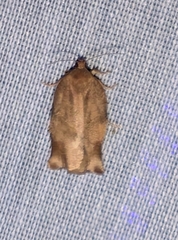 Oblique-banded Leafroller MothChoristoneura rosaceanaDamages trees, gardens or crops
 Garden TortrixClepsis peritanaDamages trees, gardens or crops
 Common MarbleSyricoris lacunanaDamages trees, gardens or crops
 Red-banded Leafroller MothArgyrotaenia velutinanaDamages trees, gardens or crops
 Light Brown Apple MothEpiphyas postvittanaDamages trees, gardens or crops
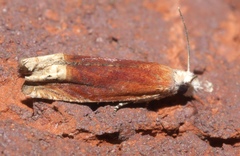 Aster and Reddish Eucosma Moths and AlliesEucosma parmatana
Sources
- Wikipedia: https://en.wikipedia.org/wiki/Rhopobota_naevana
Look it up elsewhere: GBIF · iNaturalist · BugGuide · Wikipedia
Text written 2026-10-28 from the sources above and checked sentence by sentence against them. Data fetched 2026-10-28.