 Bug FAQ
Grizzled Skipper
Pyrgus malvae · Order: Lepidoptera · Family: Hesperiidae
Also called: European Grizzled Skipper
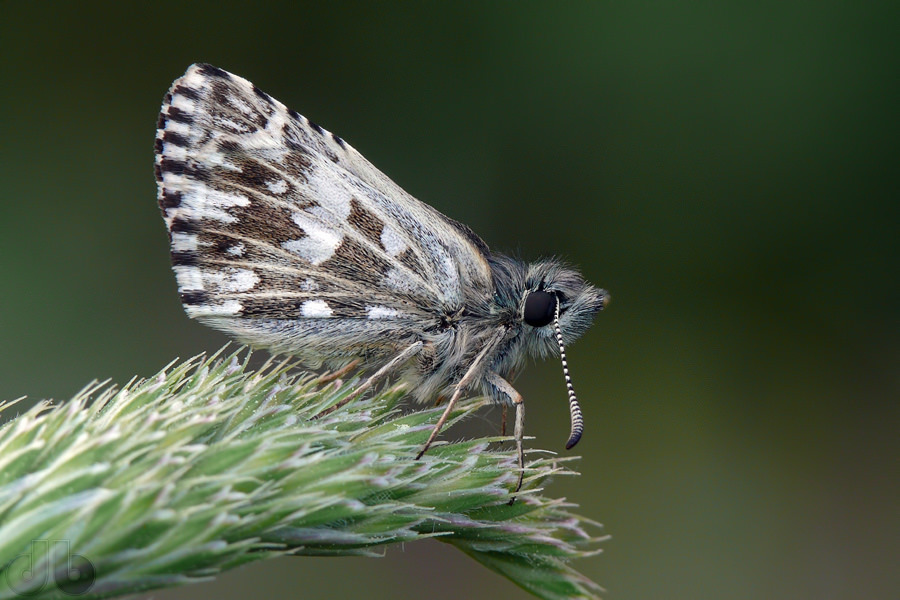
It lives in woodland, grassland and industrial areas that have spring nectar and larval food plants, flies in spring and again from late July, and prefers warmer summers. Adults feed on blue or violet flowers, lay single eggs on several host plants, and the larvae spin cocoons on their last host plant to overwinter.
Source: Wikipedia
How to recognize it
It shows a chequered black-and-white wing pattern; males’ wings are a bit more angular than the rounded wings of females.
Source: Wikipedia
Size
The average forewing diameter is about 12 mm.
Source: Wikipedia
Where it lives
It prefers woodland, grassland and industrial sites that contain spring nectar and larval food plants.
Source: Wikipedia
What it eats
Adult butterflies are active by day and favor blue or violet-coloured flowers for nectar.
Source: Wikipedia
Life cycle
Females lay eggs one at a time on various host plants; larvae later spin cocoons on the last host plant they use and remain there until spring.
Source: Wikipedia
When you see it
They are on the wing in April-May and again from late July onward, with warmer summers boosting their numbers.
Source: Wikipedia
Where it comes from
Its native range covers Europe and Asia from the Mediterranean to the Amur River, including Mongolia.
Source: Wikipedia
Lookalikes
The species is a superspecies that includes three semispecies: malvae, malvoides and melotis.
Source: Wikipedia
More photos

Questions people ask
When can I see grizzled skippers?
They fly in early spring (April-May) and return from late July onward; warm summers tend to increase their numbers.
Source: Wikipedia
How can I recognise a grizzled skipper?
Look for a small butterfly about 12 mm across with a black-and-white chequered wing pattern; males have slightly angular wings, females more rounded.
Source: Wikipedia
Same family (Hesperiidae)




Sources
- Wikipedia: https://en.wikipedia.org/wiki/Pyrgus_malvae
Look it up elsewhere: GBIF · iNaturalist · BugGuide · Wikipedia
Text written 2026-10-22 from the sources above and checked sentence by sentence against them. Data fetched 2026-10-22.