 Bug FAQ
Green tree locust
Cyrtacanthacris aeruginosa · Order: Orthoptera · Family: Acrididae


The green tree locust is a large grasshopper that lives in African grasslands. It belongs to the genus Cyrtacanthacris and includes three subspecies that share a common ancestor. The species has one generation per year; adults mate, females lay eggs that enter a seven-month diapause before hatching in 45 to 67 days.
Source: Wikipedia
Size
It is a large species of grasshopper.
Source: Wikipedia
Where it lives
It inhabits grassland areas in Africa.
Source: Wikipedia
Life cycle
The green tree locust is univoltine, producing one brood each year and its eggs undergo diapause. Adults mate before the dry season, the female lays eggs and dies; the eggs remain in diapause for about seven months and then incubate for 45 to 67 days.
Source: Wikipedia
Where it comes from
Its native range is the grasslands of Africa.
Source: Wikipedia
Lookalikes
The three subspecies are the main look-alikes within the genus Cyrtacanthacris.
Source: Wikipedia
More photos


Questions people ask
What is the life cycle of the green tree locust?
It produces one generation per year; adults mate, the female lays eggs that enter a seven-month diapause and then hatch after 45 to 67 days.
Source: Wikipedia
Same family (Acrididae)
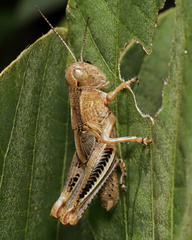 Differential GrasshopperMelanoplus differentialisDamages trees, gardens or crops
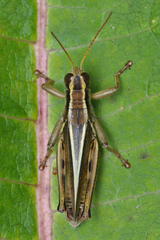 Two-striped GrasshopperMelanoplus bivittatusDamages trees, gardens or crops
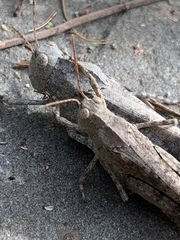 Carolina GrasshopperDissosteira carolinaDamages trees, gardens or crops
 Common Field GrasshopperChorthippus brunneus
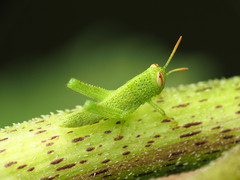 Egyptian Bird GrasshopperAnacridium aegyptium
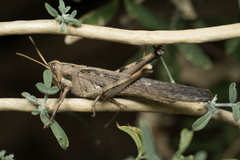 Gray Bird GrasshopperSchistocerca nitensDamages trees, gardens or crops
Sources
- Wikipedia: https://en.wikipedia.org/wiki/Cyrtacanthacris_aeruginosa
Look it up elsewhere: GBIF · iNaturalist · BugGuide · Wikipedia
Text written 2026-10-23 from the sources above and checked sentence by sentence against them. Data fetched 2026-10-23.