 Bug FAQ
Green Metalwing
Neurobasis chinensis · Order: Odonata · Family: Calopterygidae
Also called: Chinese Greenwing, Oriental Greenwing, Stream Glory
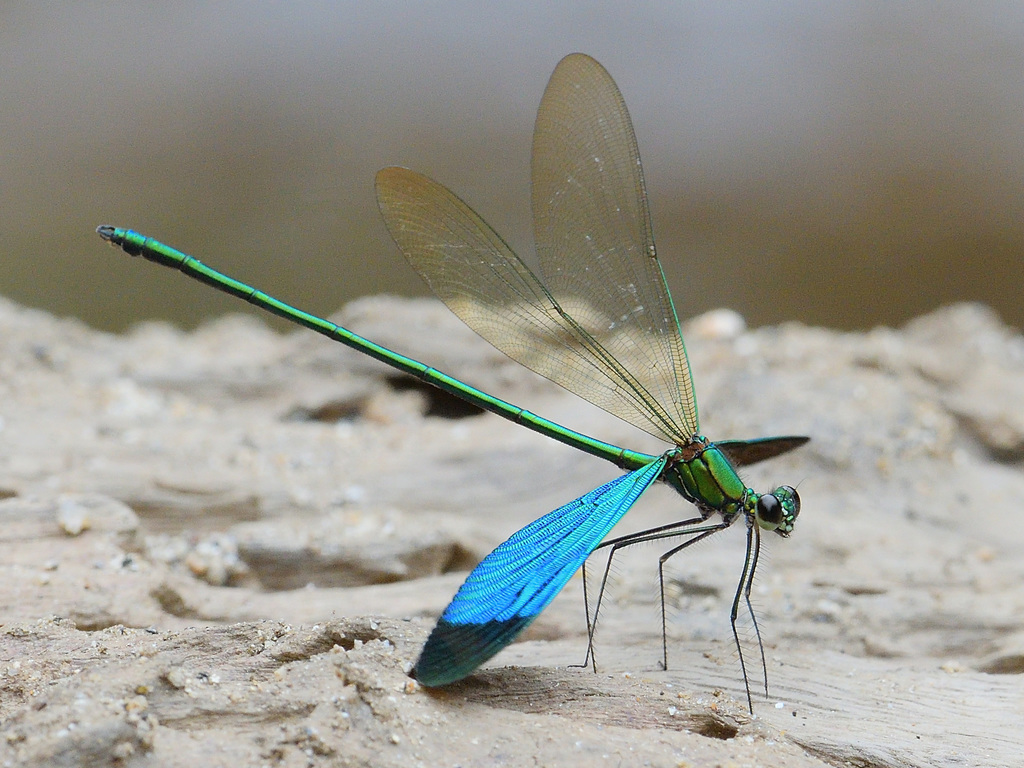
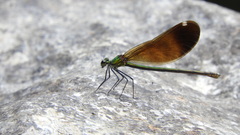
The Green Metalwing is a large damselfly with a metallic bronze-green body. It lives near forest streams and other water bodies, where females lay eggs on submerged vegetation and the larvae burrow in the sediment.
Source: Wikipedia
How to recognize it
The fore-wings are transparent with a pale yellow tint and green veins, while the hind-wings appear opaque metallic green or peacock-blue depending on the angle.
Source: Wikipedia
Size
It is a large damselfly with a metallic bronze-green coloration.
Source: Wikipedia
Where it lives
It breeds in forest streams and is normally found only near water bodies.
Source: Wikipedia
What it eats
The aquatic larvae (naiads) live buried in sediment and have a long abdomen held recurved above the body.
Source: Wikipedia
Life cycle
Females lay eggs on submerged vegetation, often among root masses. The naiads burrow in underwater sediment and keep their long abdomen recurved above the body.
Source: Wikipedia
Where it comes from
It is a common species throughout much of Asia.
Source: Wikipedia
Lookalikes
Females look very similar to males.
Source: Wikipedia
Questions people ask
Where can I find Green Metalwing damselflies?
They are usually seen near forest streams and other water bodies.
Source: Wikipedia
What do the larvae of Green Metalwing look like?
The larvae live buried in sediment and have a long abdomen held recurved above the body.
Source: Wikipedia
How do Green Metalwing damselflies reproduce?
Females lay their eggs on submerged vegetation, often among root masses.
Source: Wikipedia
Can I tell males and females apart?
Females are very similar in appearance to males.
Source: Wikipedia
Same family (Calopterygidae)


Sources
- Wikipedia: https://en.wikipedia.org/wiki/Neurobasis_chinensis
Look it up elsewhere: GBIF · iNaturalist · BugGuide · Wikipedia
Text written 2026-10-23 from the sources above and checked sentence by sentence against them. Data fetched 2026-10-22.