 Bug FAQ
Banded Demoiselle
Calopteryx splendens · Order: Odonata · Family: Calopterygidae
Also called: Banded Agrion, Banded Demoiselle Damselfly
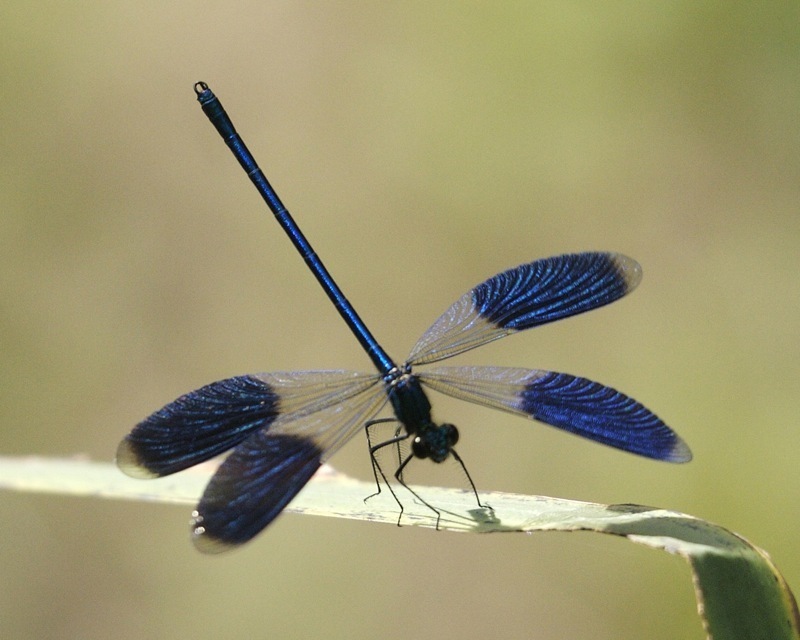
The banded demoiselle is a large damselfly up to 48 mm long, found near streams and quiet rivers across Eurasia. Males have translucent wings with a broad dark blue-black band, while females have pale green iridescent wings with a white tip patch and a metallic green or bronze body. Eggs hatch in about two weeks, the larvae develop over two years, and adults perform an aerial wing-dance courtship.
Source: Wikipedia
How to recognize it
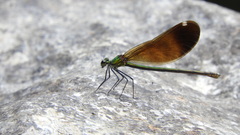
Males show a wide dark iridescent blue-black band across the outer part of each translucent wing.
Source: Wikipedia
Size
Total body length can reach up to 48 mm (1.9 in) and the hindwing can be as long as 36 mm (1.4 in).
Source: Wikipedia
Where it lives
They live in many freshwater habitats, especially open running waters such as streams and small rivers.
Source: Wikipedia
What it eats
Females can lay up to ten eggs per minute for about 45 minutes. The aquatic larvae have very long legs and a stick-shaped body.
Source: Wikipedia
Life cycle
Eggs hatch after roughly 14 days. Development from egg to adult usually takes about two years.
Source: Wikipedia
When you see it
It is a common species throughout most of its range.
Source: Wikipedia
Where it comes from
The species is Eurasian, occurring from the Atlantic coast eastward to Lake Baikal and north-western China.
Source: Wikipedia
Lookalikes
The similar beautiful demoiselle (Calopteryx virgo) has its dark wing patch start before the nodus, unlike the banded demoiselle.
Source: Wikipedia
More photos
Questions people ask
How can I tell a male from a female?
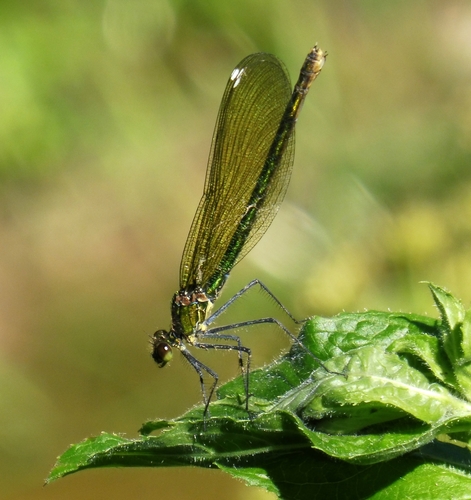
Males have a dark blue-black band on each wing; females have pale-green wings with a white tip patch and a metallic green or bronze body.
Source: Wikipedia
Where should I look for them?
Search near streams, small rivers, canals, or quiet rivers with muddy bottoms in open countryside.
Source: Wikipedia
Same family (Calopterygidae)


Sources
- Wikipedia: https://en.wikipedia.org/wiki/Banded_demoiselle
Look it up elsewhere: GBIF · iNaturalist · BugGuide · Wikipedia
Text written 2026-10-22 from the sources above and checked sentence by sentence against them. Data fetched 2026-10-22.