 Bug FAQ
Green Lynx Spider
Peucetia viridans · Order: Araneae · Family: Oxyopidae
Also called: lynx spiders
Source: Wikipedia

Females grow up to about 22 mm, males about 12 mm long. They hunt insects, including crop pests and beneficial bees, and are active by day.
Source: Wikipedia
How to recognize it
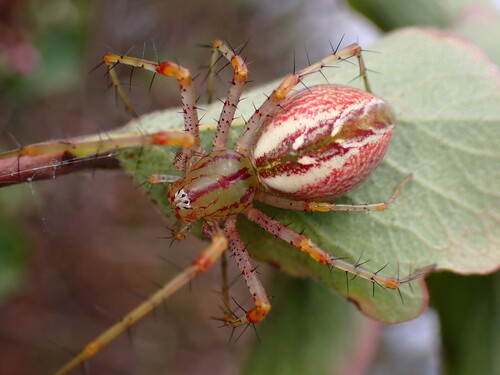
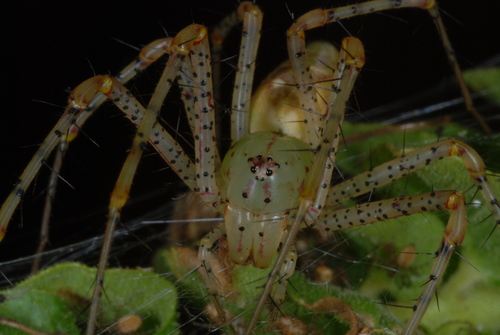
A red patch often appears between the eyes and a few red spots are on the body. The abdomen’s back shows about six forward-pointing chevron marks.
Source: Wikipedia
Size
Females can reach up to 22 mm (0.87 in) in body length. Males are smaller and more slender, averaging 12 mm (0.47 in).
Source: Wikipedia
Is it a pest in the house?
They are mainly valued for controlling agricultural pests, such as in cotton fields. They are active during daylight hours.
Source: Wikipedia
Does it bite or sting?
Bites are very rare; when they occur the venom causes pain but is not lethal. One bite caused a swelling about 25 mm around the bite for two days; another caused a larger swelling up to 20 cm in diameter.
Source: Wikipedia
Where it lives
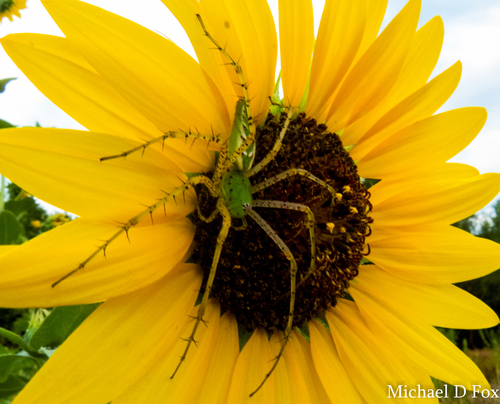
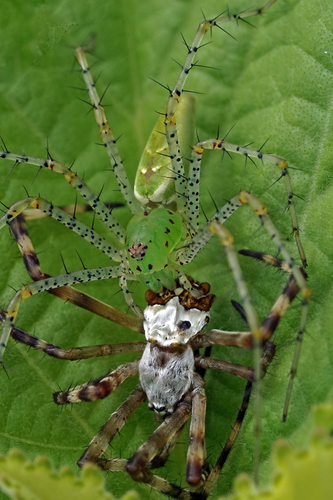
They are bright-green lynx spiders that live on green plants. Lynx spiders are plant-dwelling hunters.
Source: Wikipedia
What it eats
They catch moths and their larvae, including major crop pests such as bollworm, cotton leafworm and cabbage looper. They also prey on beneficial insects like honey bees.
Source: Wikipedia
Life cycle
In September to October the female makes one to five 2 cm egg sacs, each holding 25 to 600 bright orange eggs, which she guards while hanging upside down. Eggs hatch in about two weeks; spiderlings emerge fully functional after another two weeks and pass through eight instars to mature.
Source: Wikipedia
When you see it
Late in the season they may change from green to a paler yellow.
Source: Wikipedia
Lookalikes
It can be confused with Peucetia longipalpis, which has a shorter, fatter, more domed abdomen and less distinct dorsal markings. Do not mix it up with P. viridana (India/Myanmar) or P. viridis (Spain/Africa).
Source: Wikipedia
Where it is found in the US
Recorded in 26 of 51 states and DC. Most records: Texas, Florida, California, North Carolina, Georgia, Alabama, South Carolina, Oklahoma.
Darker = more records. Counts are museum and citizen-science records, not population size.
Source: GBIF
Status: native in North America; native in United States. Source: iNaturalist
Months it is reported in the US
Source: GBIF
More photos
Questions people ask
Do green lynx spiders bite humans?
They rarely bite; if they do, the bite is painful but not deadly.
Source: Wikipedia
Are they harmful to crops?
They actually help by hunting many crop-pest moths, though they also eat beneficial insects like bees.
Source: Wikipedia
How can I tell this spider from similar species?
Look for a red patch between the eyes, six forward-pointing chevrons on the abdomen, and a slimmer body than P. longipalpis.
Source: Wikipedia
Same family (Oxyopidae)


Sources
- Wikipedia: https://en.wikipedia.org/wiki/Peucetia_viridans
Look it up elsewhere: GBIF · iNaturalist · BugGuide · ITIS · Wikipedia
Text written 2026-10-22 from the sources above and checked sentence by sentence against them. Data fetched 2026-10-22.