 Bug FAQ
Green Dock Beetle
Gastrophysa viridula · Order: Coleoptera · Family: Chrysomelidae
Also called: Green Dock Leaf Beetle
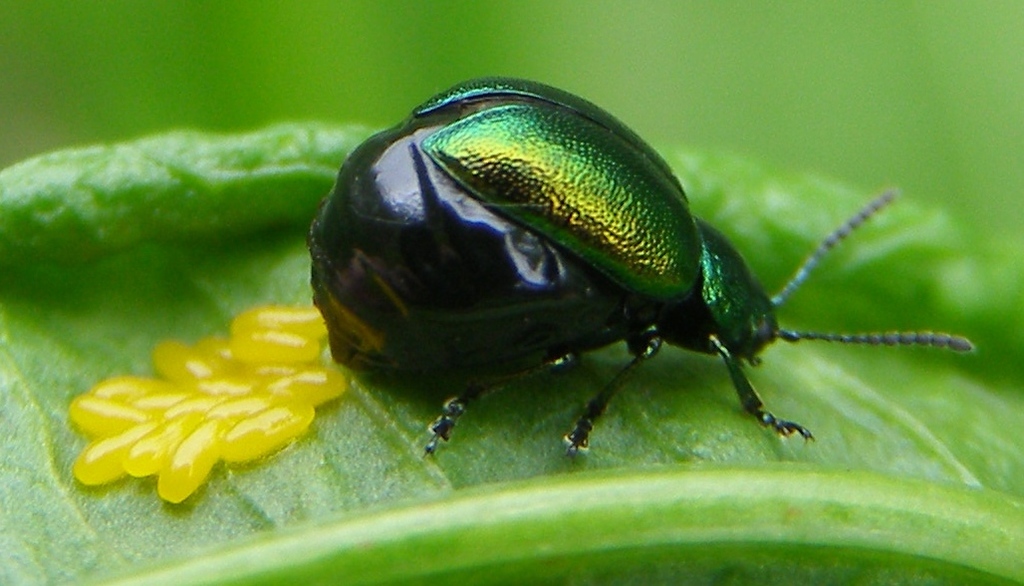
The green dock beetle is a small metallic green beetle that lives where dock plants grow. It feeds mainly on dock and green sorrel, and its larvae can only develop on Rumex species. It breeds from March to October, producing several generations each year, with the final generation hibernating as adults.
Source: Wikipedia
How to recognize it
The legs are also metallic green and are strongly built.
Source: Wikipedia
Size
Males are about 4 mm long, while females are about 7 mm long.
Source: Wikipedia
What it eats
Adults feed mainly on dock and green sorrel, and only occasionally on other plants in the Polygonaceae, Brassicaceae, Violaceae, and Boraginaceae families. Larvae can complete development only on Rumex species.
Source: Wikipedia
Life cycle
Breeding occurs from March through October. There are two to four generations per year, and the last generation hibernates as an adult.
Source: Wikipedia
When you see it
The beetle’s active season runs from March to October.
Source: Wikipedia
Lookalikes
In North America, a similar species called Gastrophysa cyanea is also referred to as the green dock beetle.
Source: Wikipedia
Where it is found in the US
Recorded in 2 of 51 states and DC. Most records: Nebraska, Colorado.
Darker = more records. Counts are museum and citizen-science records, not population size.
Source: GBIF
Same family (Chrysomelidae)
 Spotted Cucumber BeetleDiabrotica undecimpunctataDamages trees, gardens or crops
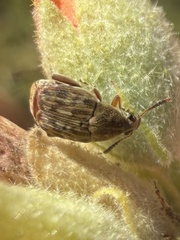 Bean WeevilAcanthoscelides obtectusDamages trees, gardens or crops
 Cowpea WeevilCallosobruchus maculatusDamages trees, gardens or crops
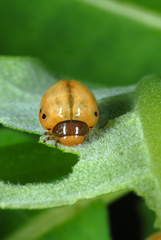 Swamp Milkweed Leaf BeetleLabidomera clivicollisDamages trees, gardens or crops
 Alder Leaf BeetleAgelastica alniDamages trees, gardens or crops
 Dogbane Leaf BeetleChrysochus auratus
Sources
- Wikipedia: https://en.wikipedia.org/wiki/Gastrophysa_viridula
Look it up elsewhere: GBIF · iNaturalist · BugGuide · Wikipedia
Text written 2026-10-22 from the sources above and checked sentence by sentence against them. Data fetched 2026-10-22.